This article comes from Atlas Obscura’s Places newsletter. Subscribe or manage your subscription here.
The enterprising 19th-century journalist Nellie Bly didn’t just write stories—she stepped into danger to force readers to see things that they might prefer to ignore. Bly went undercover in the 1880s to expose the asylum system, in which women (with or without mental illness) were often abused or neglected. More than a century later, Bly’s work was honored with a monument near the site of the asylum she investigated, on New York’s Roosevelt Island.
“The Girl Puzzle,” named after one of the journalist’s early works, includes five monumental faces of women, one of them Bly’s, along with four spheres of mirror-polished steel. It’s a reminder on this International Women’s Day that progress has often depended on women who refused to accept the unacceptable.
Female visual artists have long had to struggle, not just to have their work widely seen, but to create at all. But women have made art as long as there’s been art. Many persevered, both through the strength of their work and the force of will, and in celebration of Women’s History Month, we want to highlight some of our favorite places where you can see these contributions in person. SEE THE FULL LIST
My New Favorites in the Atlas
The Music Box Theatre in Chicago is a historic 1929 cinema showing independent and classic films in an atmospheric setting.
A plane wing with the Mechanics’ Creed written on it is a roadside art installation and monument on a remote stretch of highway in Iceland.
An unexpected mix of medieval buildings and modern art enlivens this street in Morlaix, France.
Did You Know?
Visitors were drawn to mental institutions out of curiosity and compassion, but they weren’t seeing the full picture—until Nellie Bly revealed it.
It’s all about the details. That’s what makes Suzette Smart’s textile tales so very special.
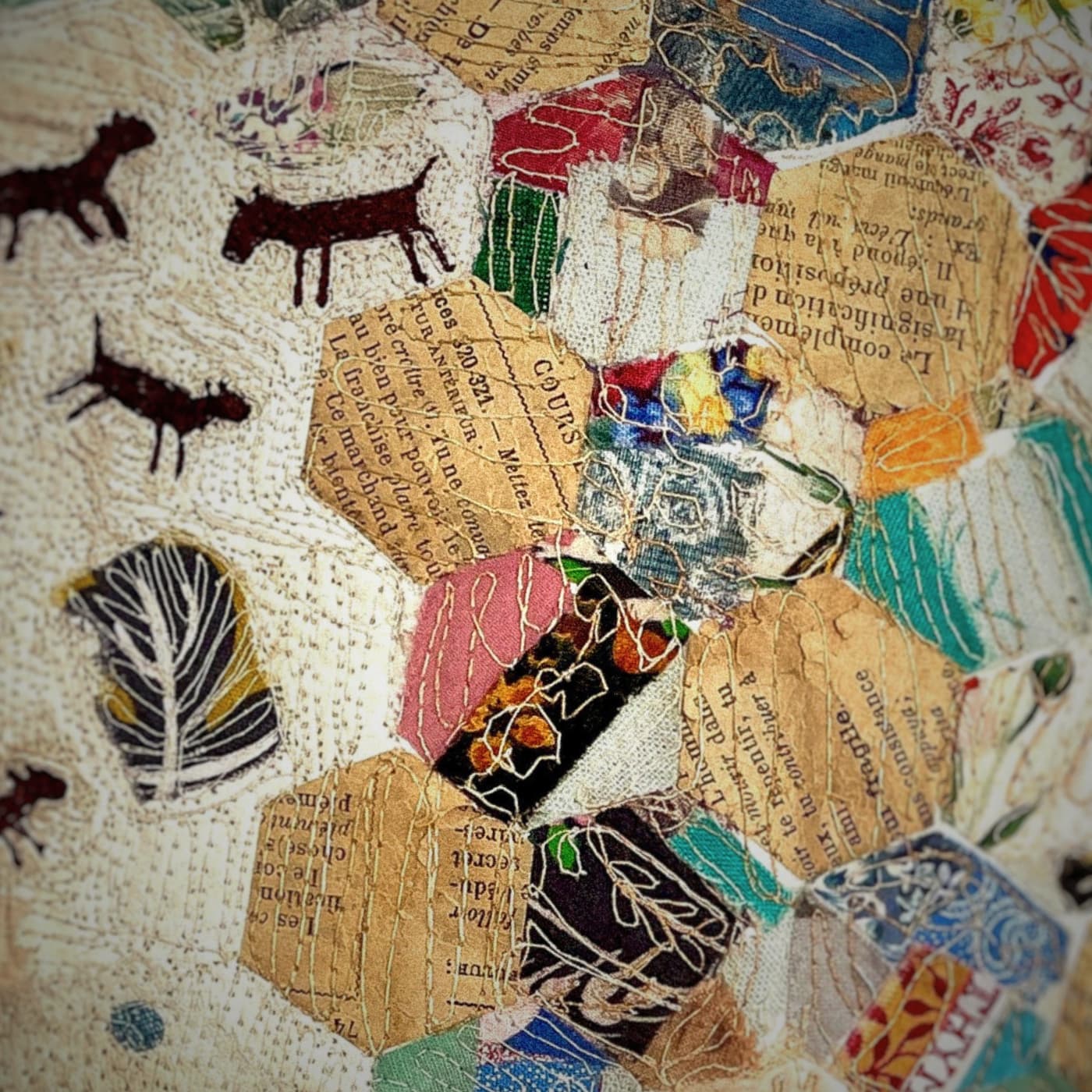
Her intricately collaged surfaces are filled with life’s small moments. Bits of landscape, shifting seasons and familiar wildlife merge seamlessly to tell stories inspired by her daily walks and travel.
There’s always a playful twist or two with stitch, paint, paper and image transfers. Cheeky animals often take centre stage. Wonky text meanders across the cloth. Even an inherited badge tells part of a story.
Thrifted fabrics and found notions bring extra charm, while machine and hand stitching build rich, textural surfaces.
Suzette’s art is packed with delicious small touches, and we can’t get enough of it. Look once and you enjoy it. Look again and you’ll likely see something new.
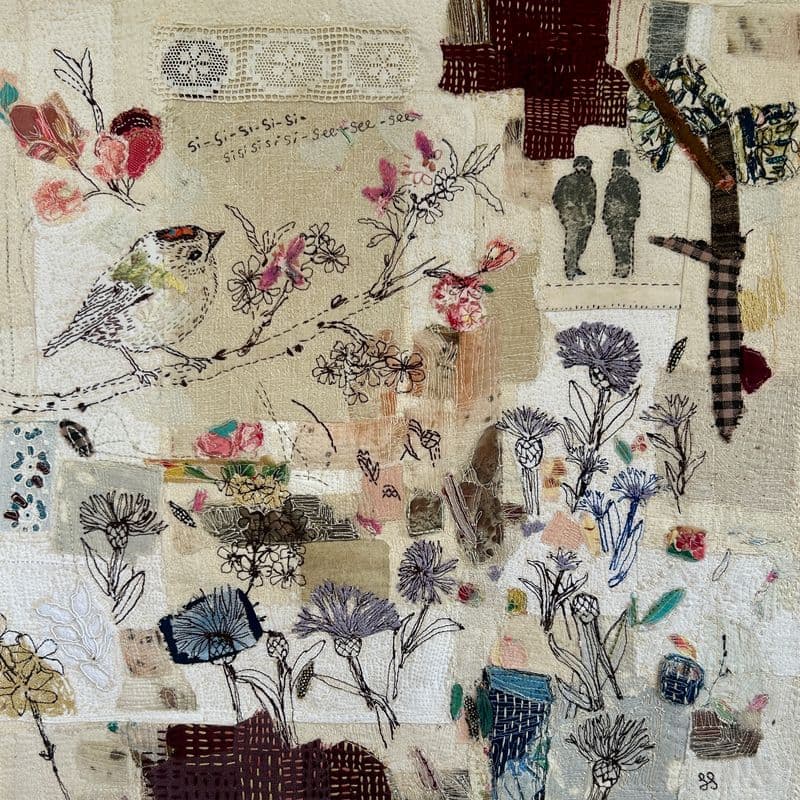
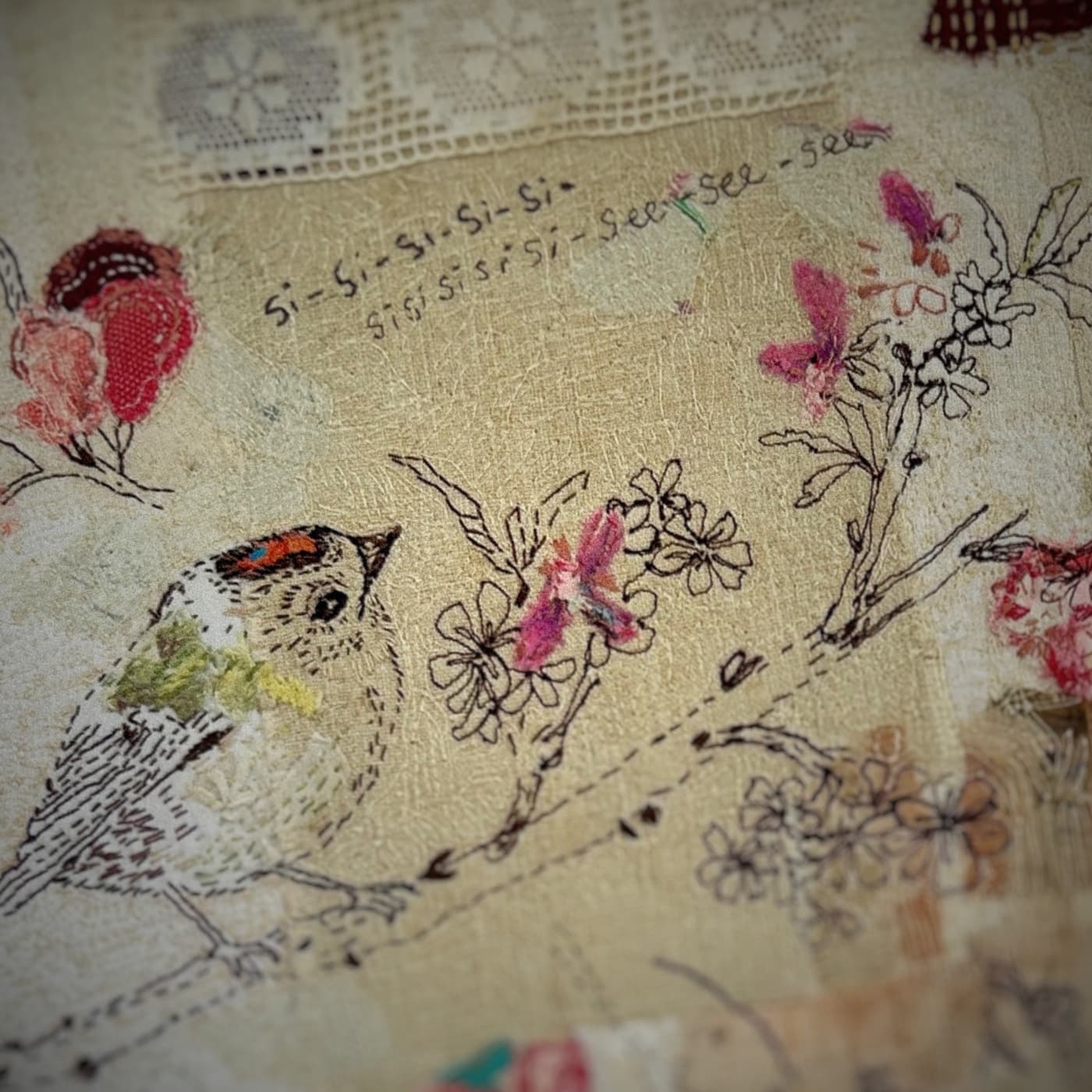
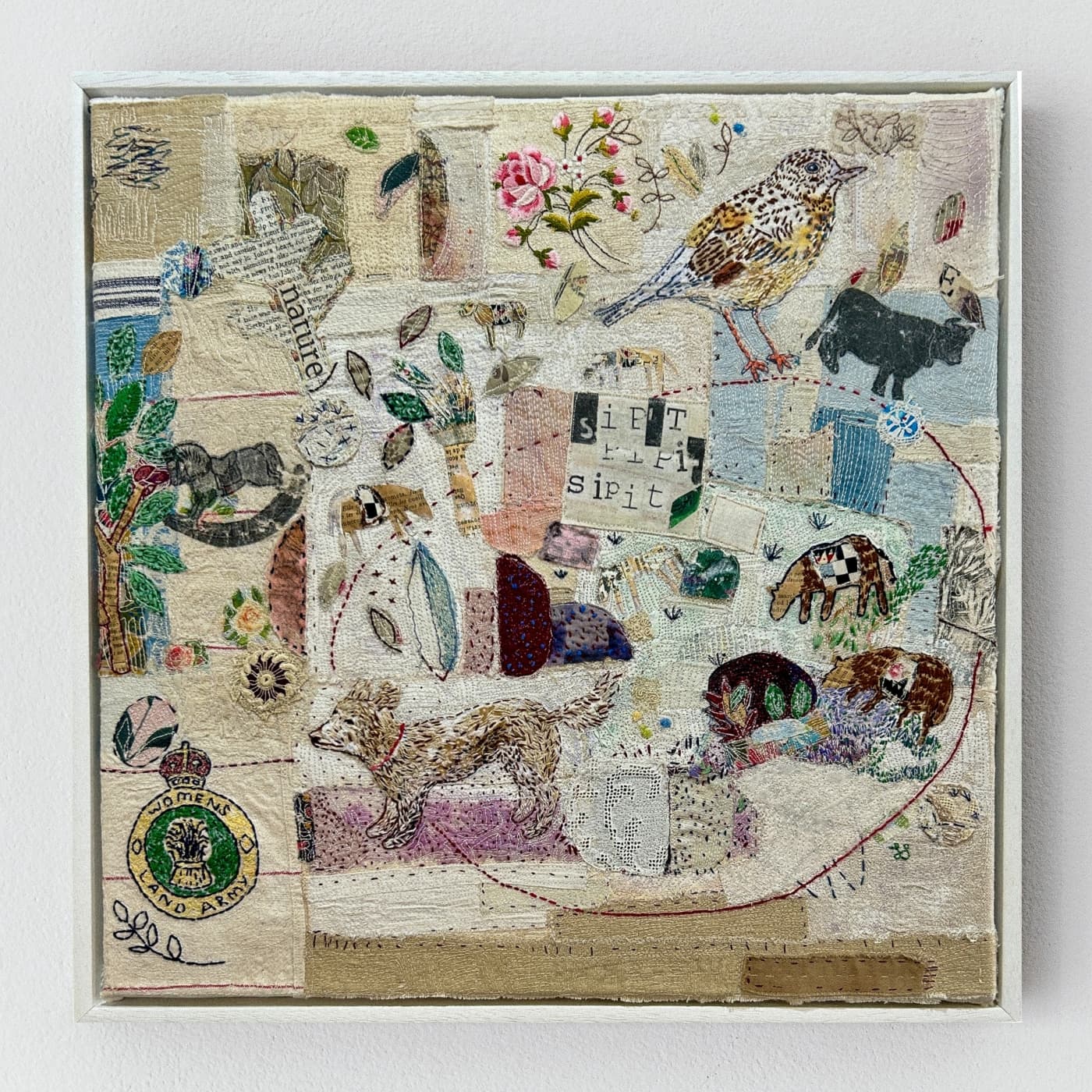
Suzette Smart, Springtime Conversation, 2025. 43cm x 43cm (17″ x 17″). Mixed media, collage, hand and machine stitching. Fabric, paint, and a variety of threads.Suzette Smart, Springtime Conversation (detail), 2025. 43cm x 43cm (17″ x 17″). Mixed media, collage, hand and machine stitching. Fabric, paint, variety of threads.
Narratives & memories
What is it about storytelling that captures your interest?
Suzette: My work is rooted in narrative and memory, drawing on the landscape, wildlife and lived experiences that shape my everyday life.
I get excited when there’s something new in the landscape to portray. I’m looking for connections and a way of bringing that something new into a piece of work. I carry motifs and themes into the next piece which creates a seamless story.
“For me, storytelling feels instinctive.”
Suzette Smart, Textile artist
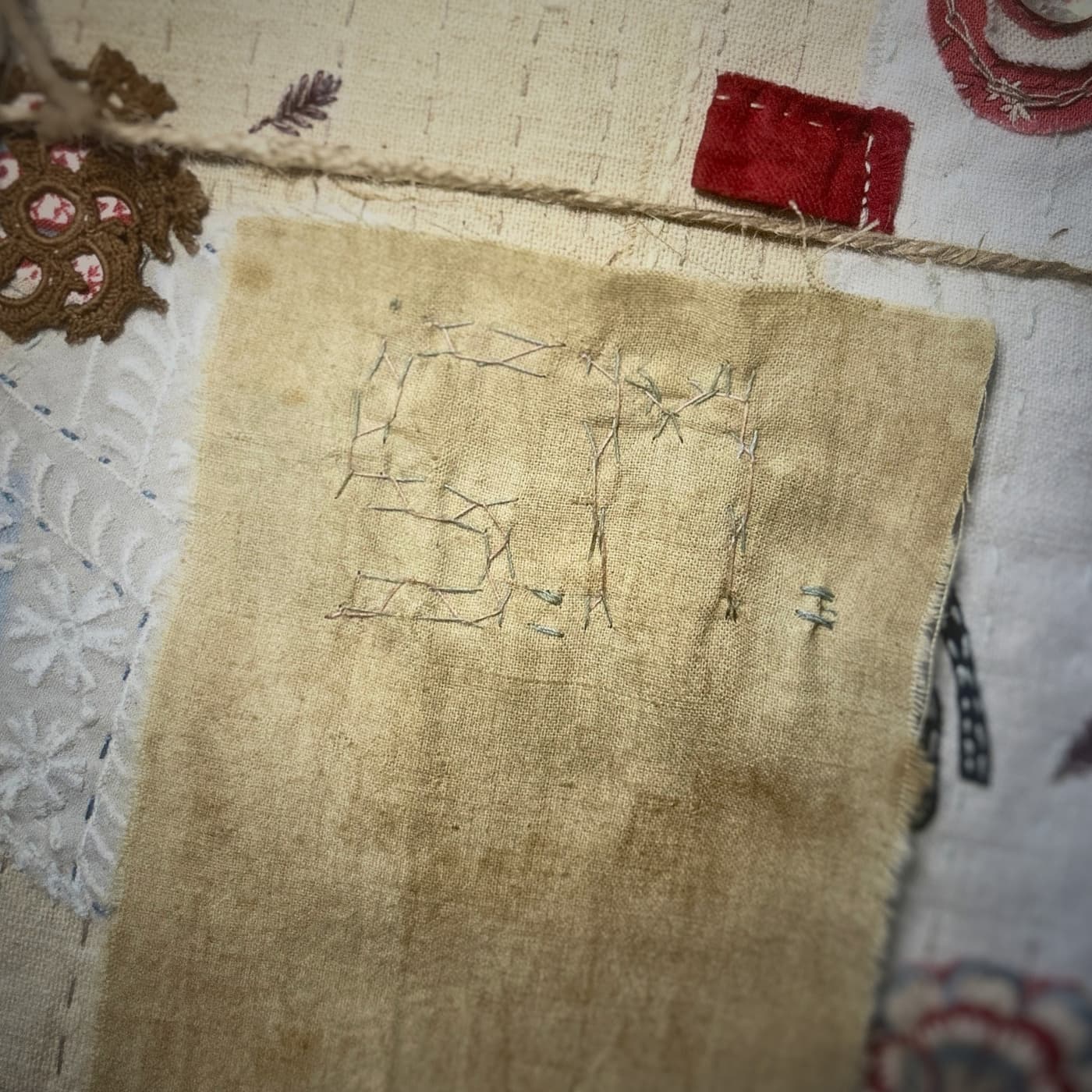
Suzette Smart, Stitchwork from My Childhood, mid-70s. 10cm x 16cm (4″ x 6″). Hand stitching. Sewing thread on grain bag.
What is one of the first textile artworks you remember creating?
My paternal grandparents lived on the island of Ynys Môn in North Wales, and I’d stay with them during the holidays. I always remember sitting at my grandmother’s feet, sewing or making something. She bought me a concertina sewing box.
My grandfather had worked in textiles manufacturing at Courtaulds, and his father had been a cotton mill director in Oldham, Lancashire. I wish I could go back and find out more, but I think this is where my textile journey must have begun.
I’ve kept a small piece of embroidery I made when I was six or seven; I stitched my initials onto my marble bag. It reminds me of sitting and creating with my grandmother.
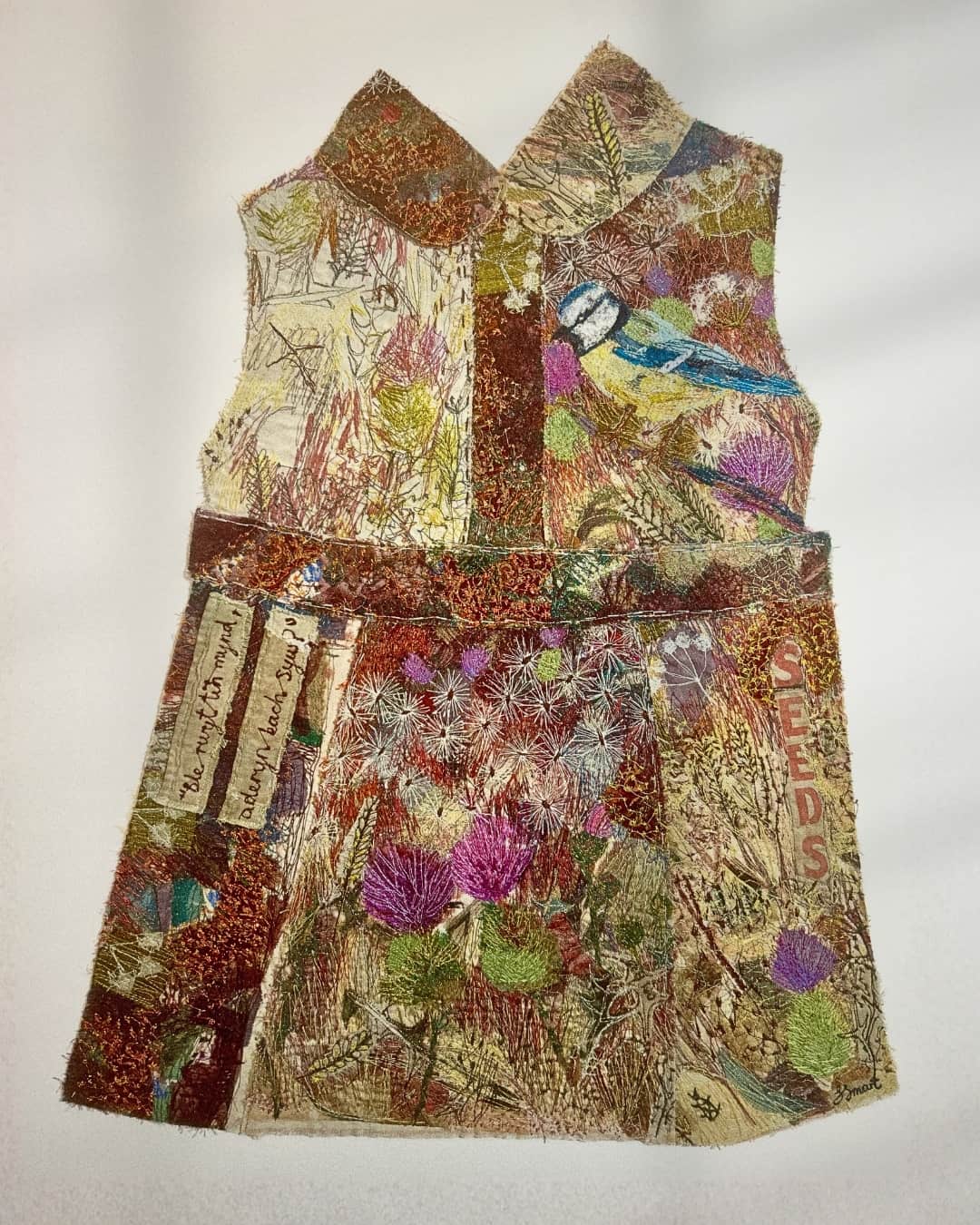
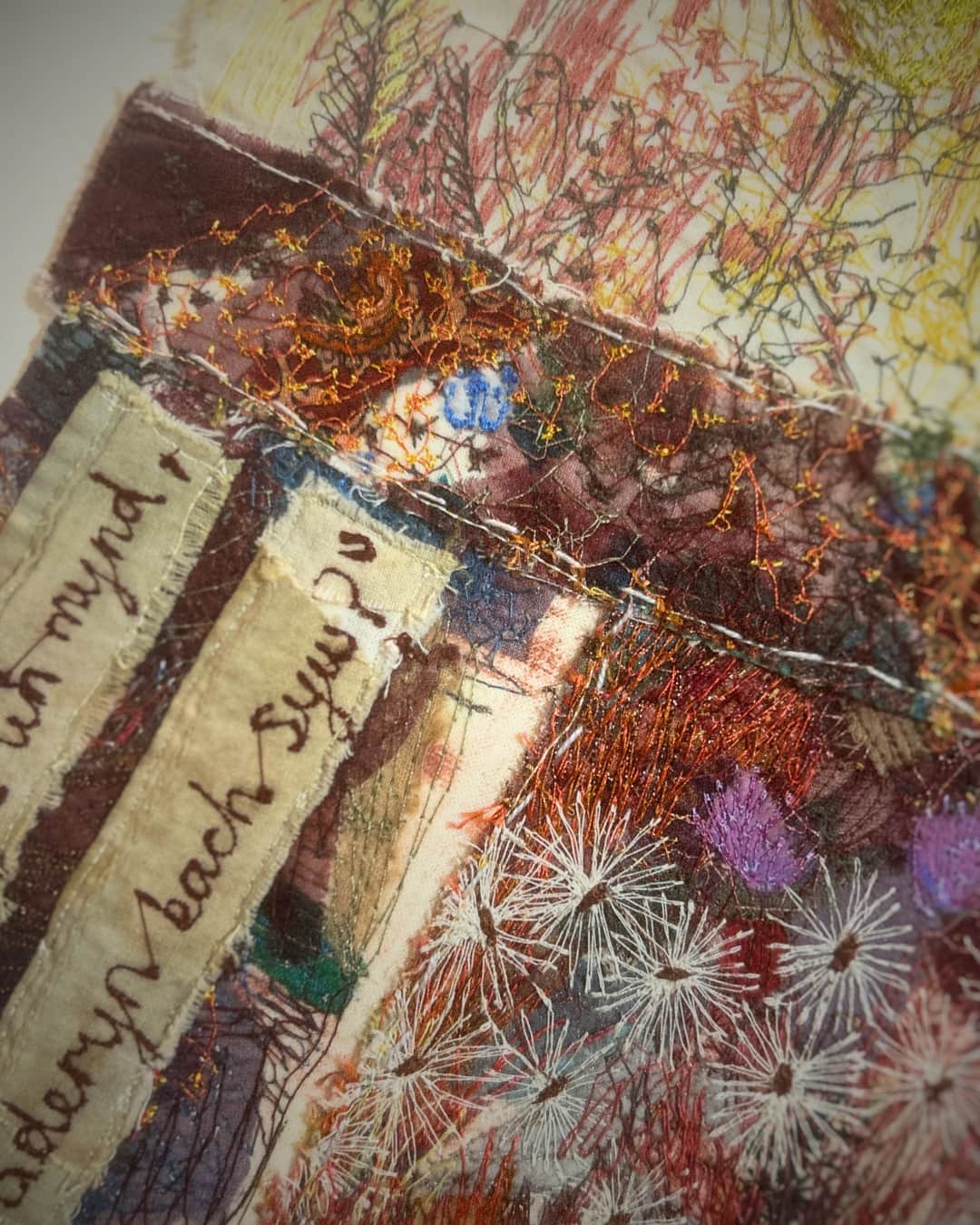
Years later, I included some of that marble bag in a child’s dress piece I made. It’s called Ble rwyt ti’n mynd, aderyn bach syw?, which means ‘where are you going to, little laden bird’? It comes from a traditional Welsh nursery rhyme.
Suzette Smart, Ble rwyt ti’n mynd, aderyn bach syw?, 2016. Collage, free machine stitching. Grain bag, fabric and thread.Suzette Smart, Ble rwyt ti’n mynd, aderyn bach syw? (detail), 2016. Collage, free machine stitching. Grain bag, fabric and thread.
What was your route to becoming a textile artist?
I took a vocational qualification (BTEC) in General Art & Design, where I had some fantastic tutors. They widened my viewpoint of how I could draw with collage. That stayed with me and is now a significant part of my process.
From there, I went to the University of Ulster in Belfast and studied for a BA (Hons) in fashion and textile design. I had every intention of swapping courses to embroidery, but it never happened.
It took another few years and probably a bit of life experience before I started stitching again. Thankfully, the stories had been waiting to be made. I joined a network of local artists, which I’m still part of, and I’ve been a practising artist and tutor for the last 20 years.
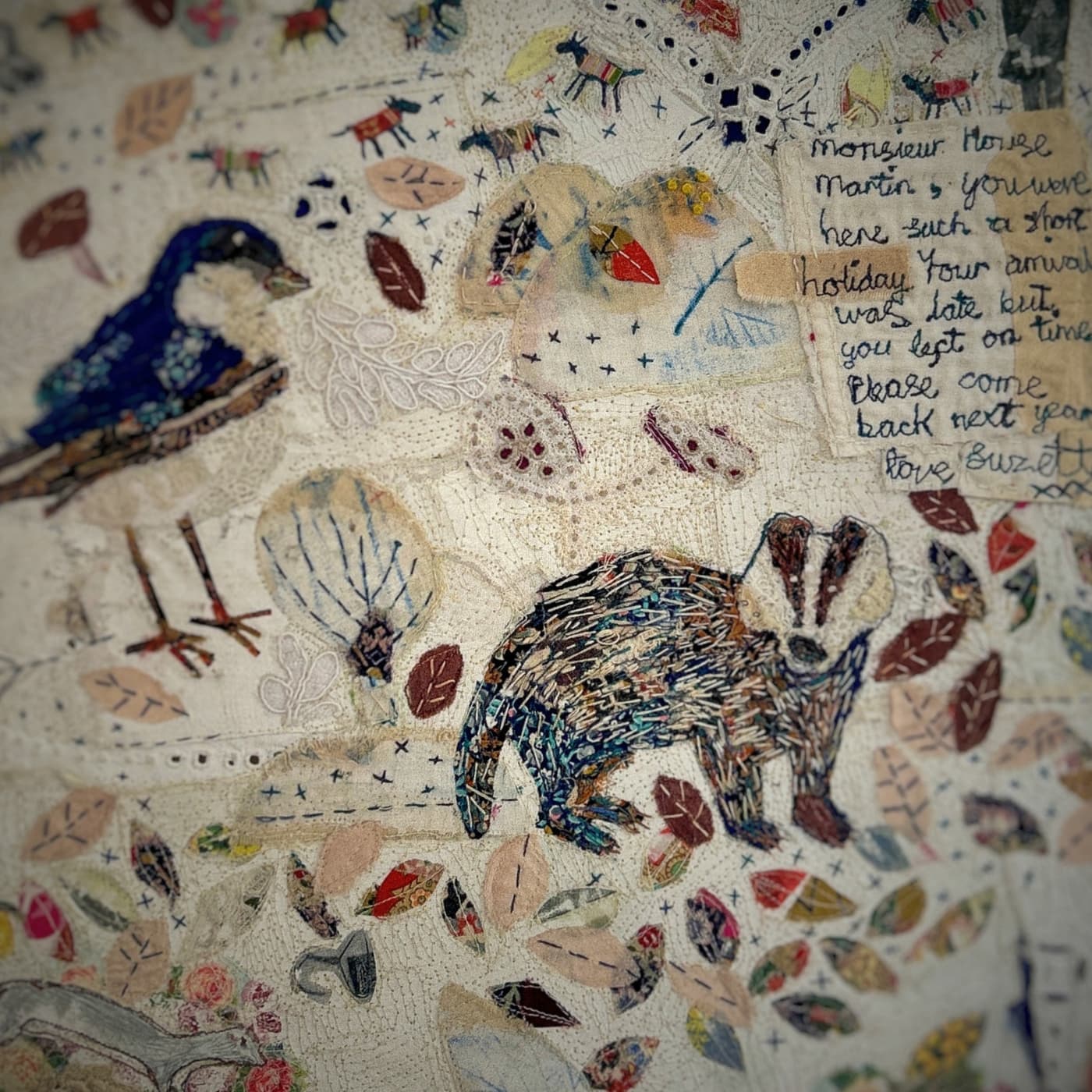
Suzette Smart,Monsieur House Martin, 2022. 43cm x 43cm (17″ x 17″). Mixed media, collage, hand and machine stitching. Fabric, paint, variety of threads.
Embracing imperfections
Tell us about your favourite fabrics and threads.
I’m drawn to older fabrics, which may be a little worn or have a social history. I’ve always enjoyed the imperfections, as it gives me something to work with. It’s harder to work with new cloth, as it doesn’t blend so easily when I’m stitching.
The free machine threads I use must be reliable and are the workhorse of a piece. I have a whole selection of light colours for blending and some favourite darks for drawn lines.
My hand stitching threads are my pleasure and reward! They’re chosen for colour, texture and thickness for the line I want. I’m always open to using new ones too.
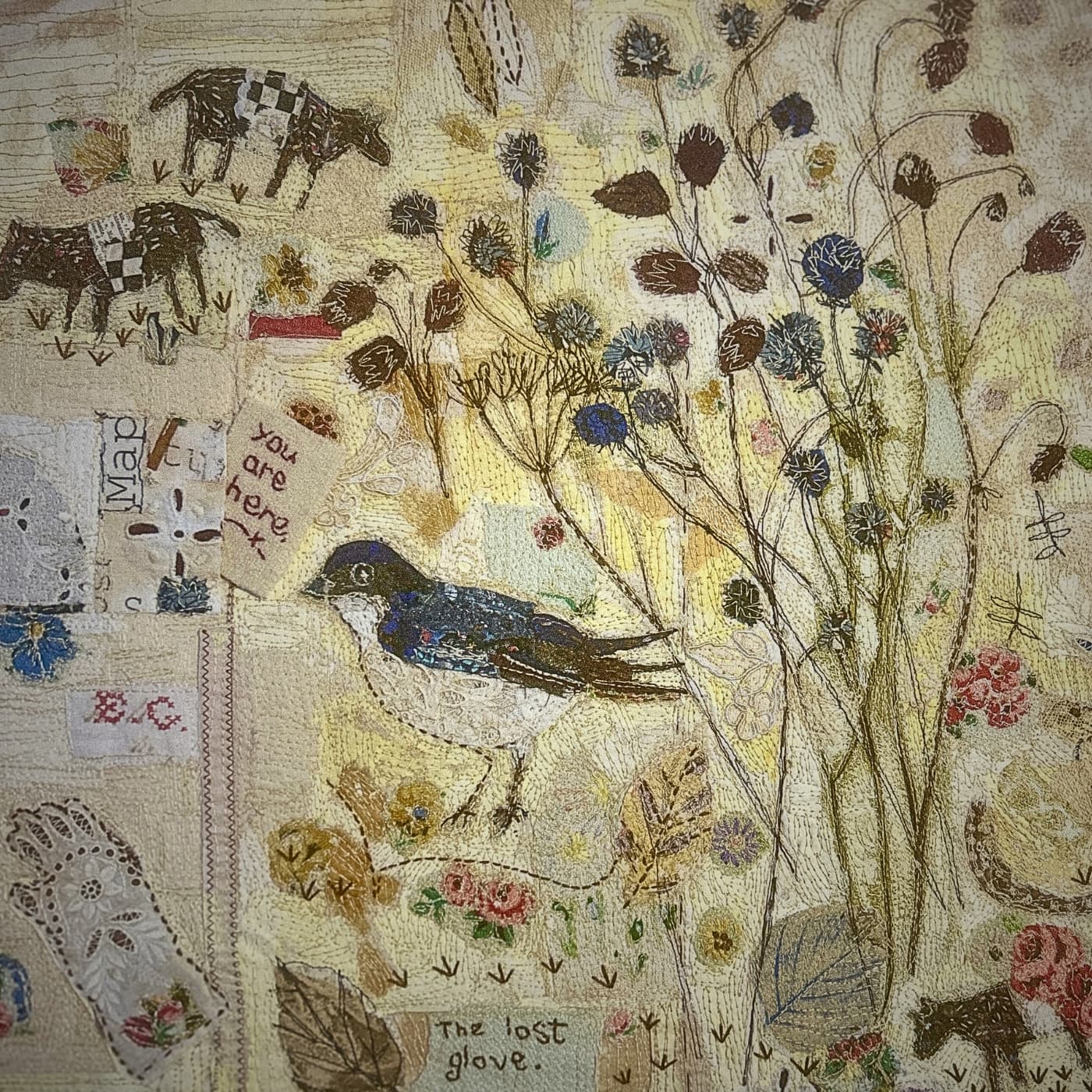
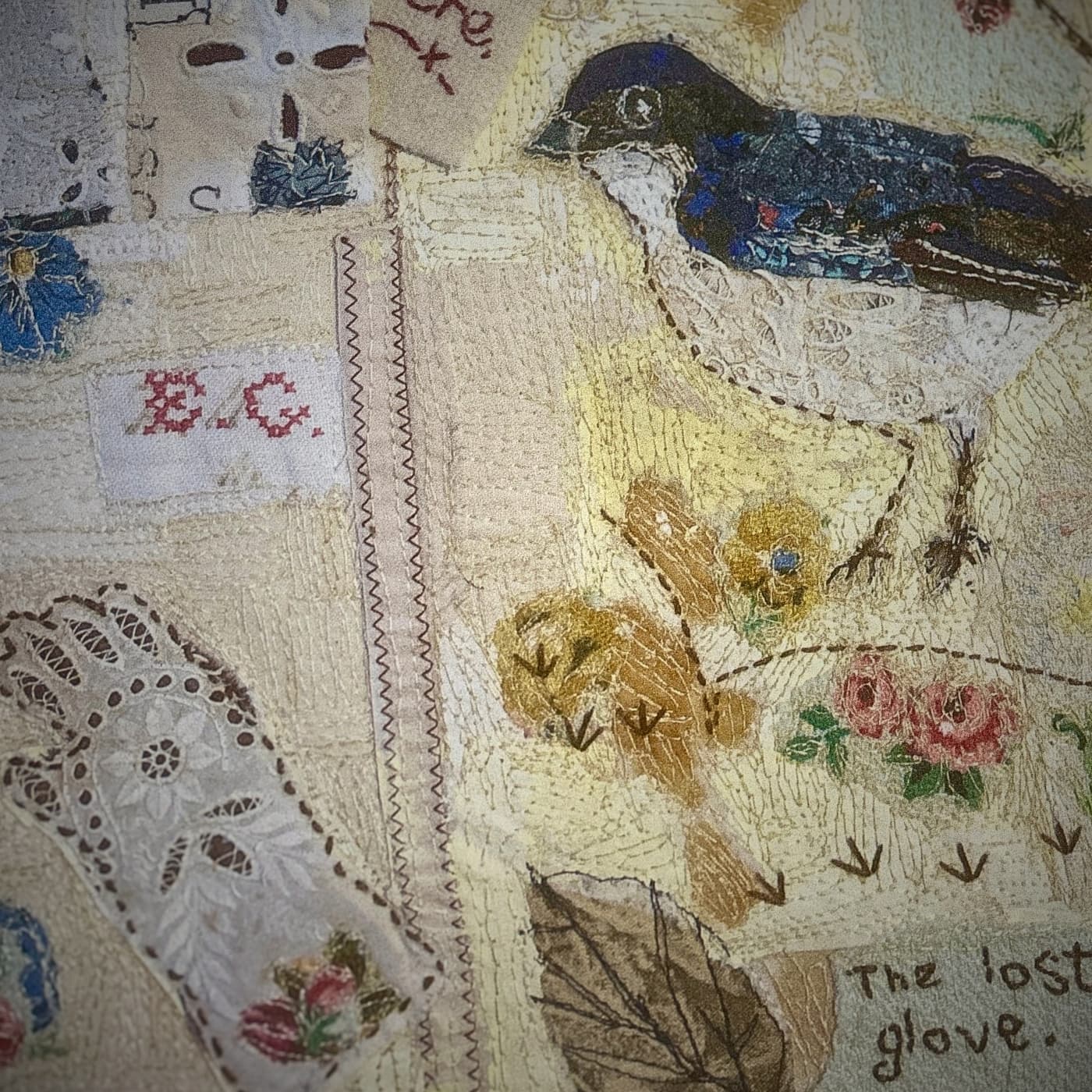
Suzette Smart, The Lost Glove, 2022. 43cm x 43cm (17″ x 17″). Collage, free machine and hand stitching. Paint, fabric, thread.Suzette Smart, The Lost Glove (detail), 2022. 43cm x 43cm (17″ x 17″). Collage, free machine and hand stitching. Paint, fabric, thread.
What are some of your signature motifs or themes?
Most of my work focuses on landscapes, wildlife and lived experiences. Birds became quite significant in my work when I was part of an exhibition called Birds of Wales at Oriel Ynys Môn in 2016. They’re often the storyteller of a piece, and I can take them back to a time and place.
My husband and I are keen walkers, and I’m often picking up motifs along the way which then reappear in a couple more pieces.
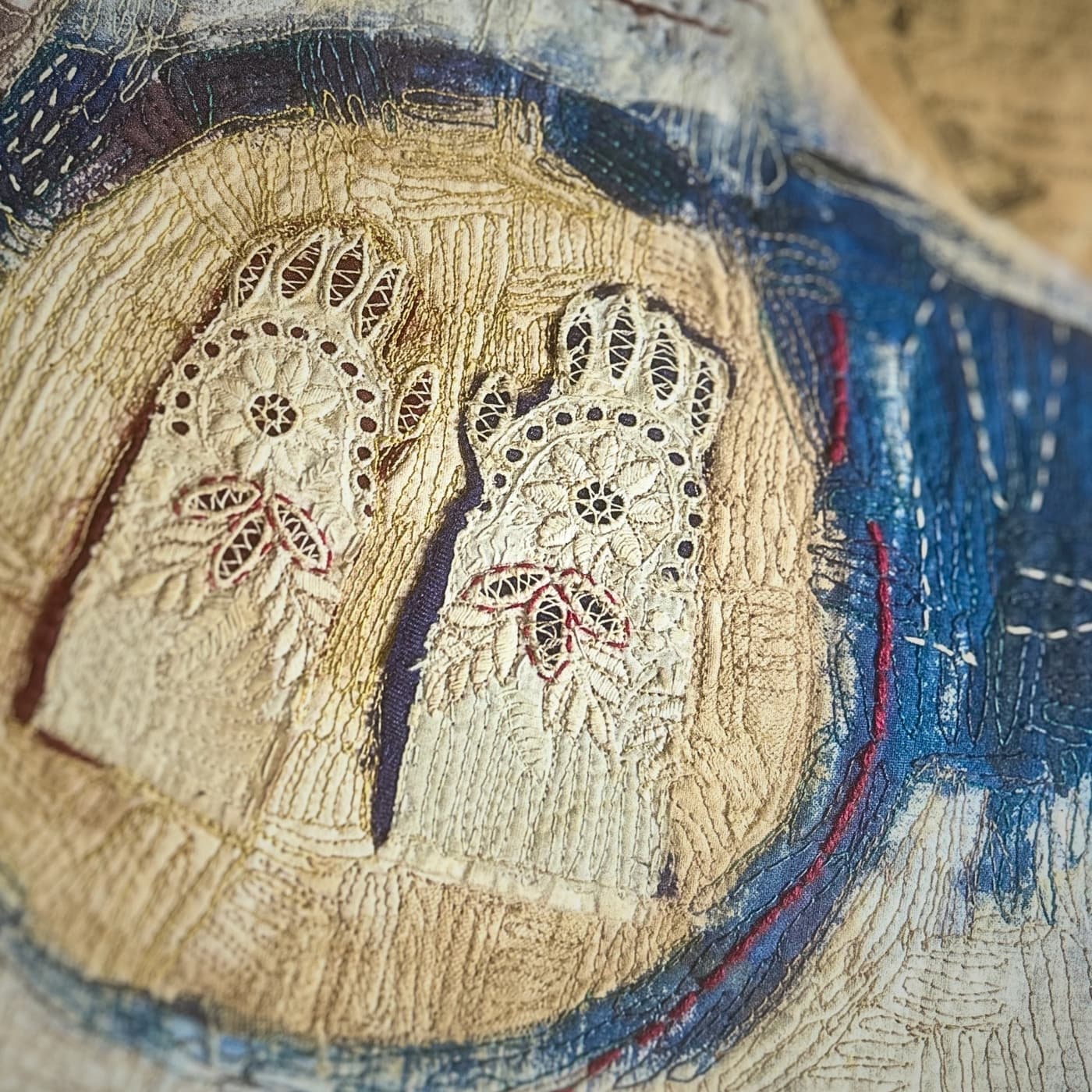
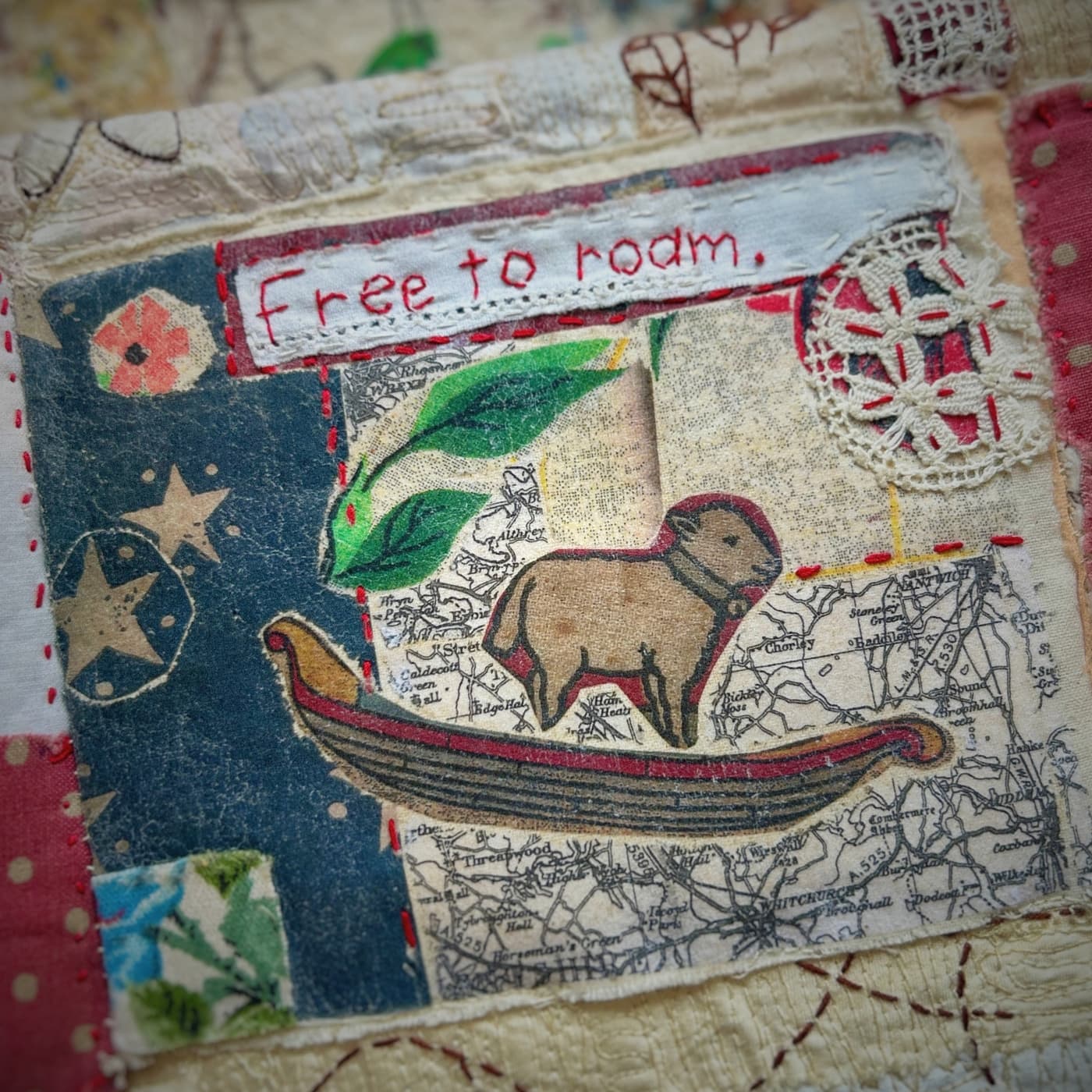
A single glove on a post became central to my work called The Lost Glove, and then it became a pair again in Free to Roam.
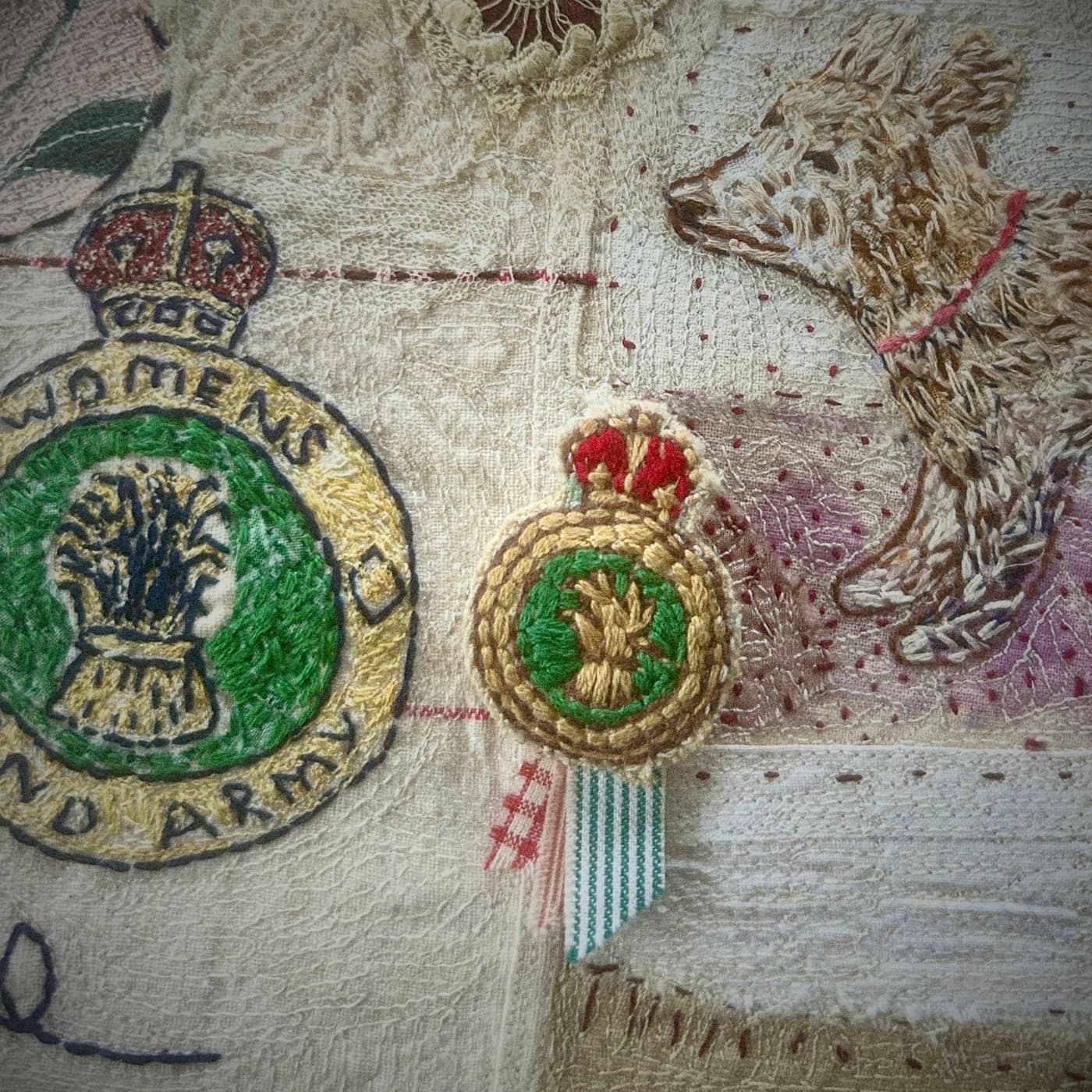
A Women’s Land Army badge from the Second World War has also made an appearance in a few pieces, and I’ve recreated it as a stitched brooch. It belonged to someone in the family, so there’s that connection too. The war led to shortages of workers on farms in the UK, so women stepped in to help grow more food and keep people fed.
Suzette Smart, hand stitched Women’s Land Army Badge
Are your pieces carefully planned or is it a more intuitive process?
It’s probably something in between. I don’t tend to sample before working on a piece, but I will refer to previous works. The main components of a composition might be decided before I begin, but there are always new things to discover along the way.
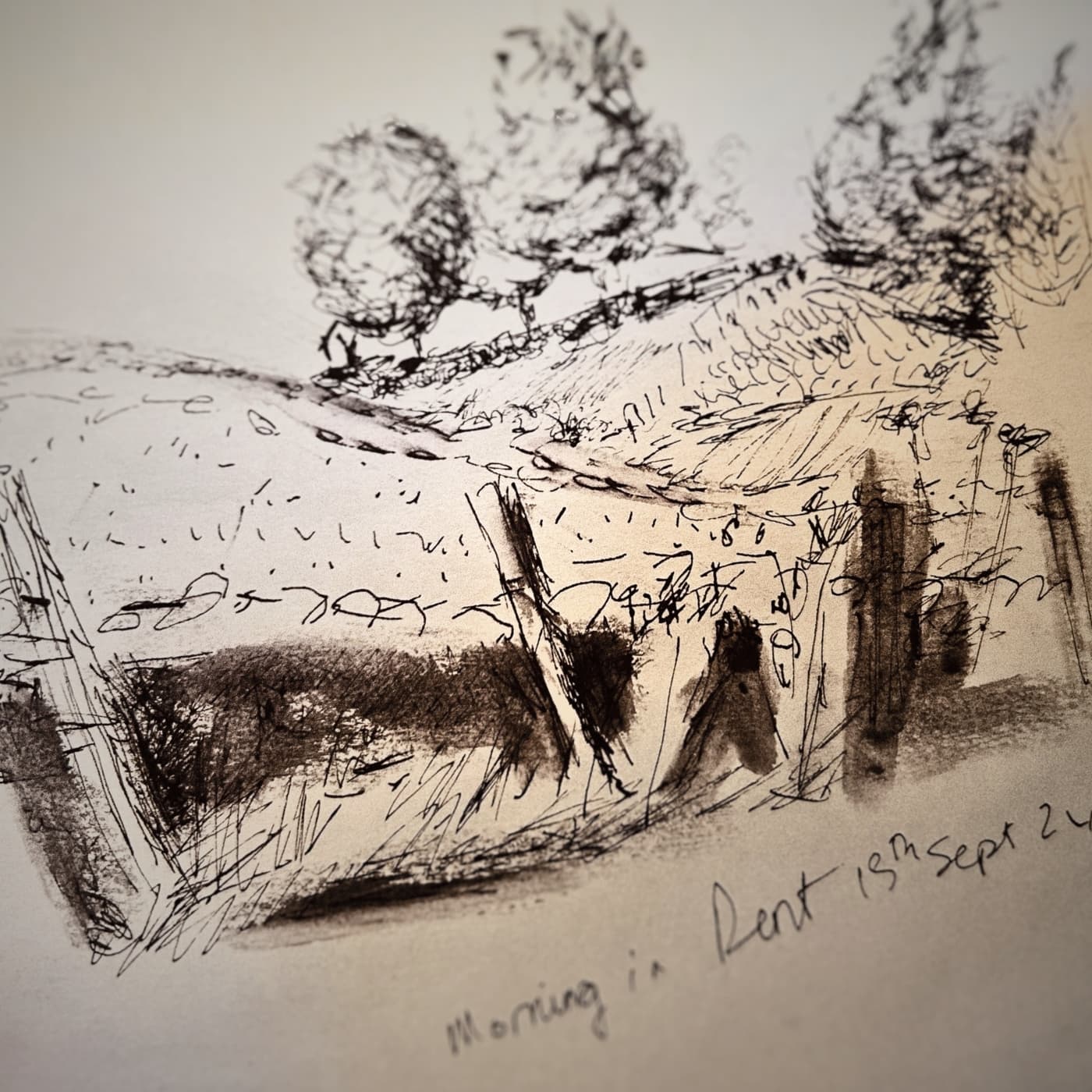
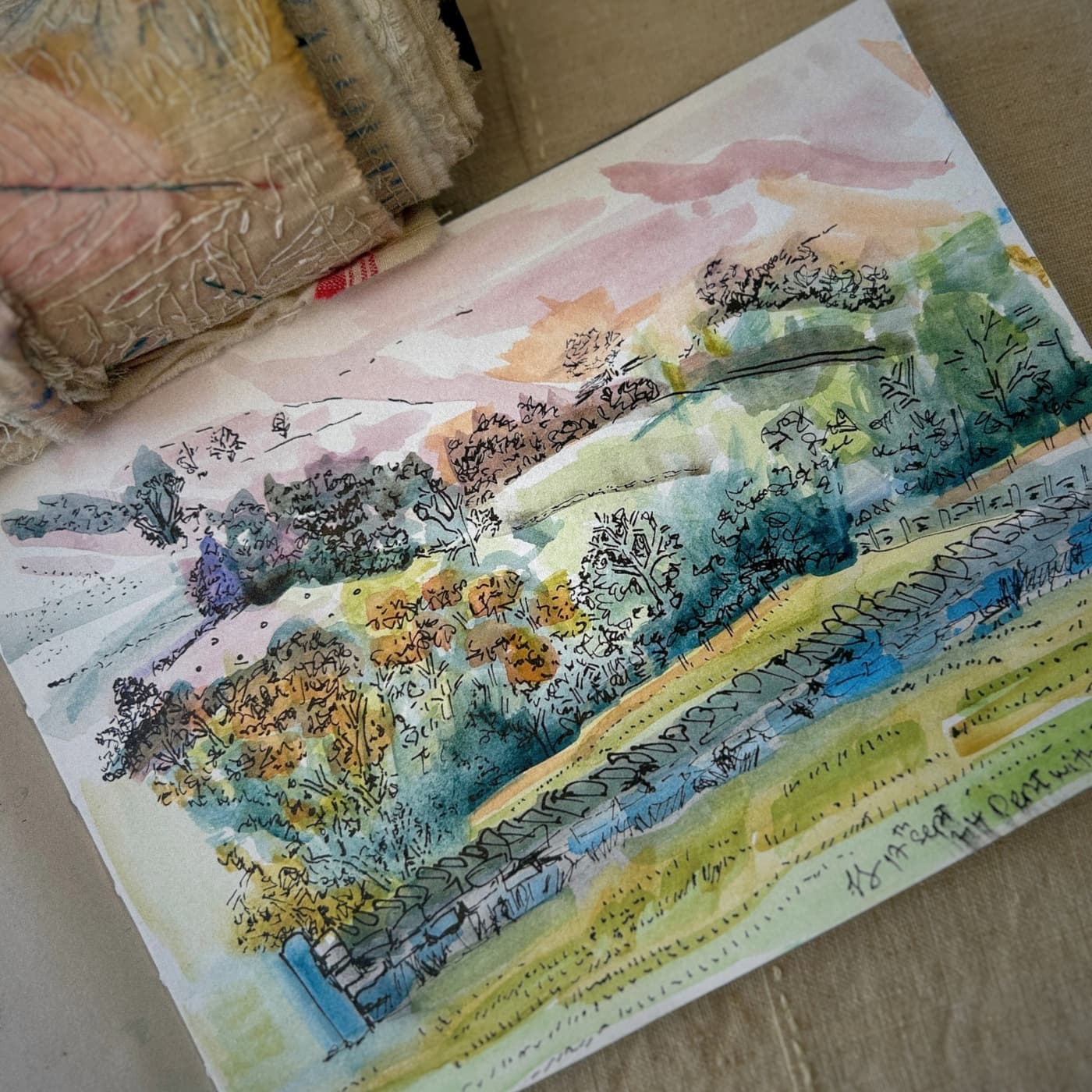
I do keep sketchbooks, which also serve as my walking and gardening diary. If I’m working on a piece, I might go wandering around the garden for inspiration and something seasonal to include.
We’ve undertaken several long-distance walks in recent years, and I’ve recorded some of the places we visited. We stay in our camper van, so there’s a lot of time spent outdoors. I might get a quick line drawing and a few notes in over a sandwich, but I can lose a couple of hours sitting out sketching when we return from a day’s walking.
I also have a few fabric scrolls on which I’ve begun stitching my walks. They’re an extension of my sketchbooks and another form of recording and mark making.
“My two favourite months for garden inspiration are spring and autumn, beginnings and endings.”
Suzette Smart, Textile artist
Suzette Smart, Sketchbook, colour washes, pen workSuzette Smart, Sketchbook and Fabric Scroll, colour washes, pen work
Repurposed materials
How would you describe your creative process?
I keep a basket of light-coloured fabric scraps to use for the background. I might paint onto some of them with gesso or tea stain to alter them. I prefer using thrifted and gifted fabrics, including linen, lace and fabric scraps.
When I collect enough fabrics from which to choose, I start moving them around to create a size I’m happy with. I then tack them together.
I start building a composition with fabric and sometimes paper. I’ll use Bondaweb fusible webbing where necessary, glue stick, pins and tacking stitches. Whatever works at the time.
Once I’m satisfied with the overall design of the collage, I’ll swap back and forth between hand and machine stitching, adding extra fabric scraps as needed along the way. I love all aspects of my process, but there’s something quite satisfying about those final stitches.
“I embrace reusing materials as both a creative and environmentally considerate practice.”
Suzette Smart, Textile artist
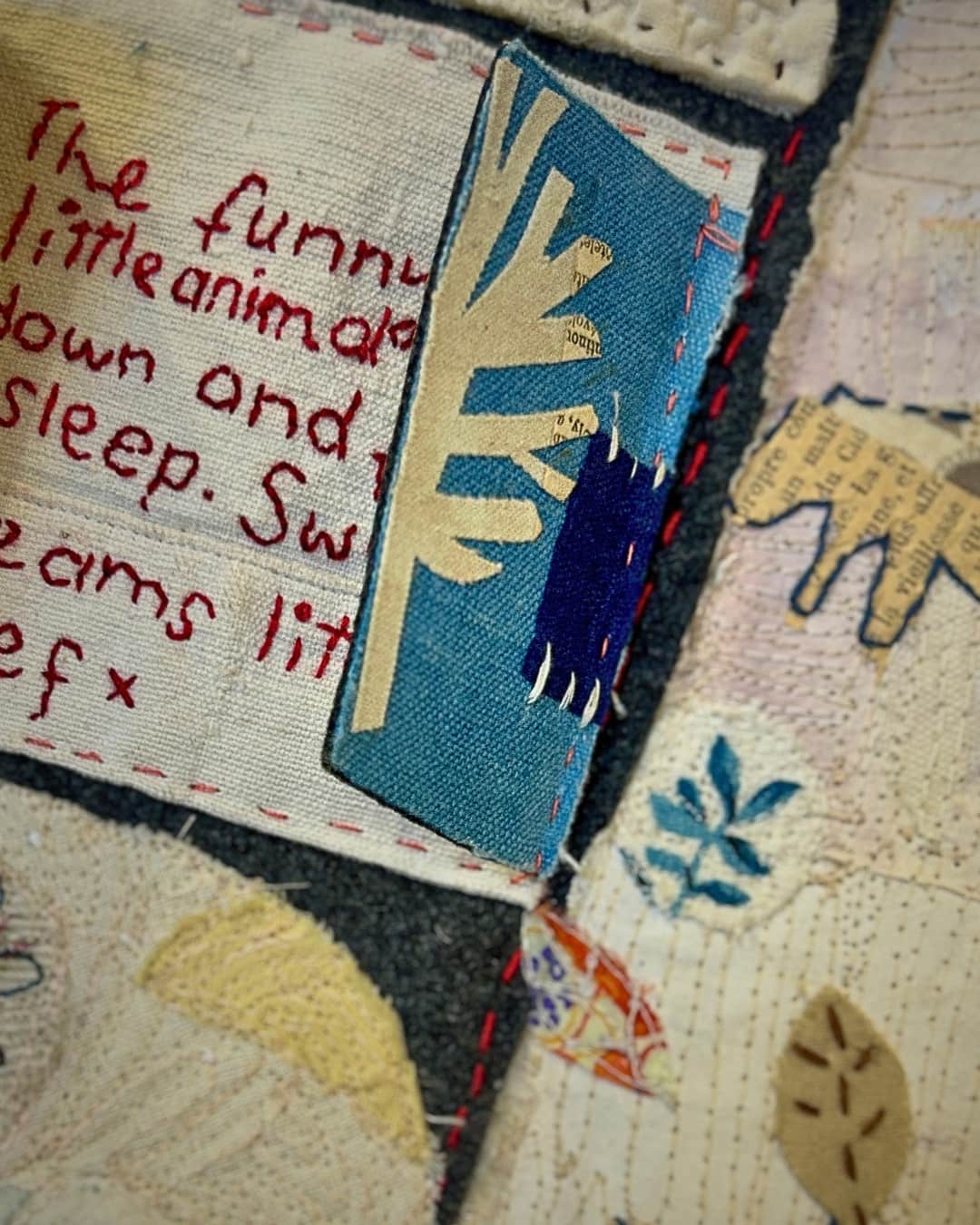
Suzette Smart, The Funny Little Animal (detail), 2023. 54cm x 68cm (21″ x 27″). Mixed media, collage, hand and machine stitching. Fabric, paint, paper, variety of threads.
Each of your works is packed with many wonderful points of interest. How do you know when to stop?
I mostly know when I’m finished with a piece, but to make sure, I’ll take a picture and crop it. This either reaffirms my thinking or exposes something I hadn’t noticed. If this happens, I might leave it for a week before changing anything.
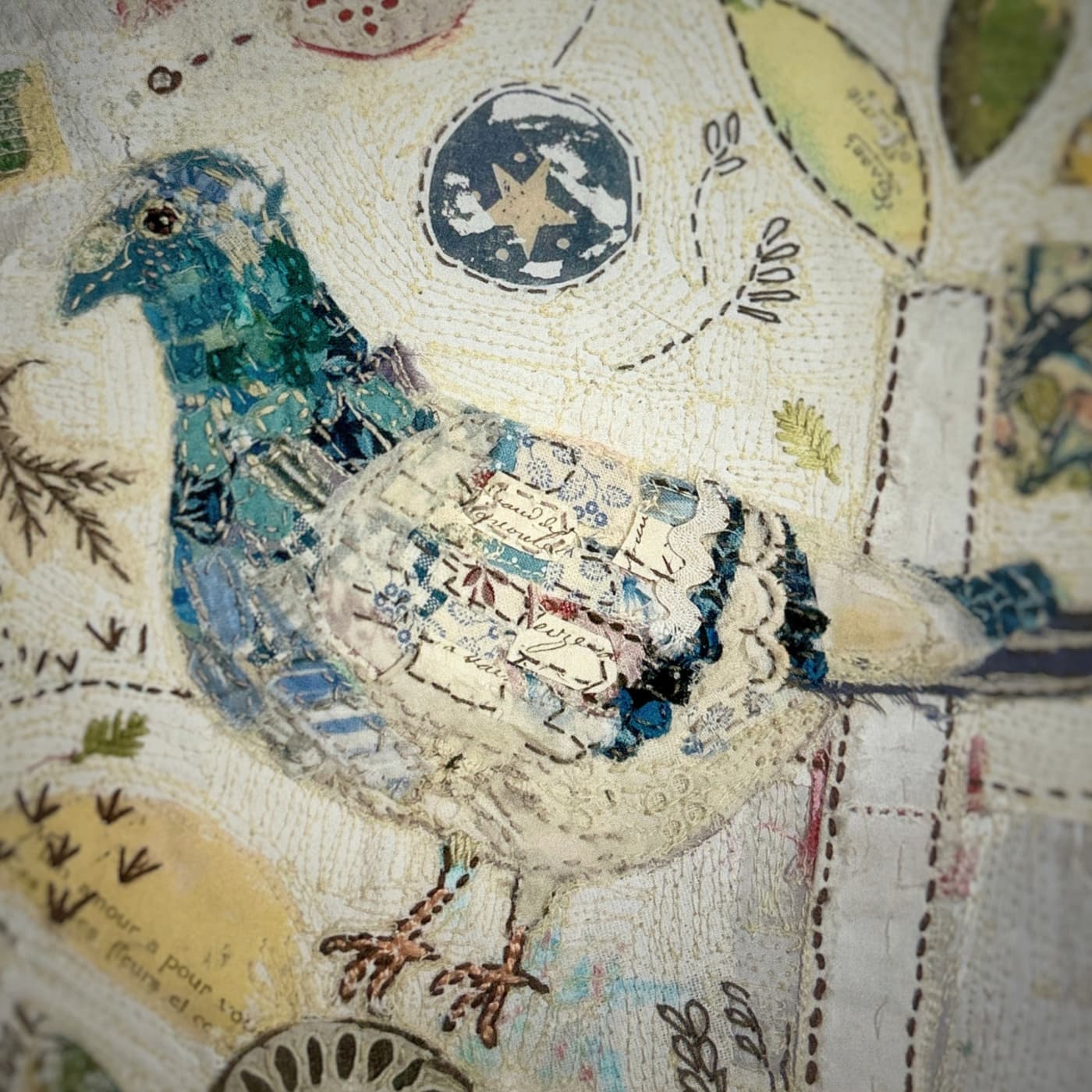
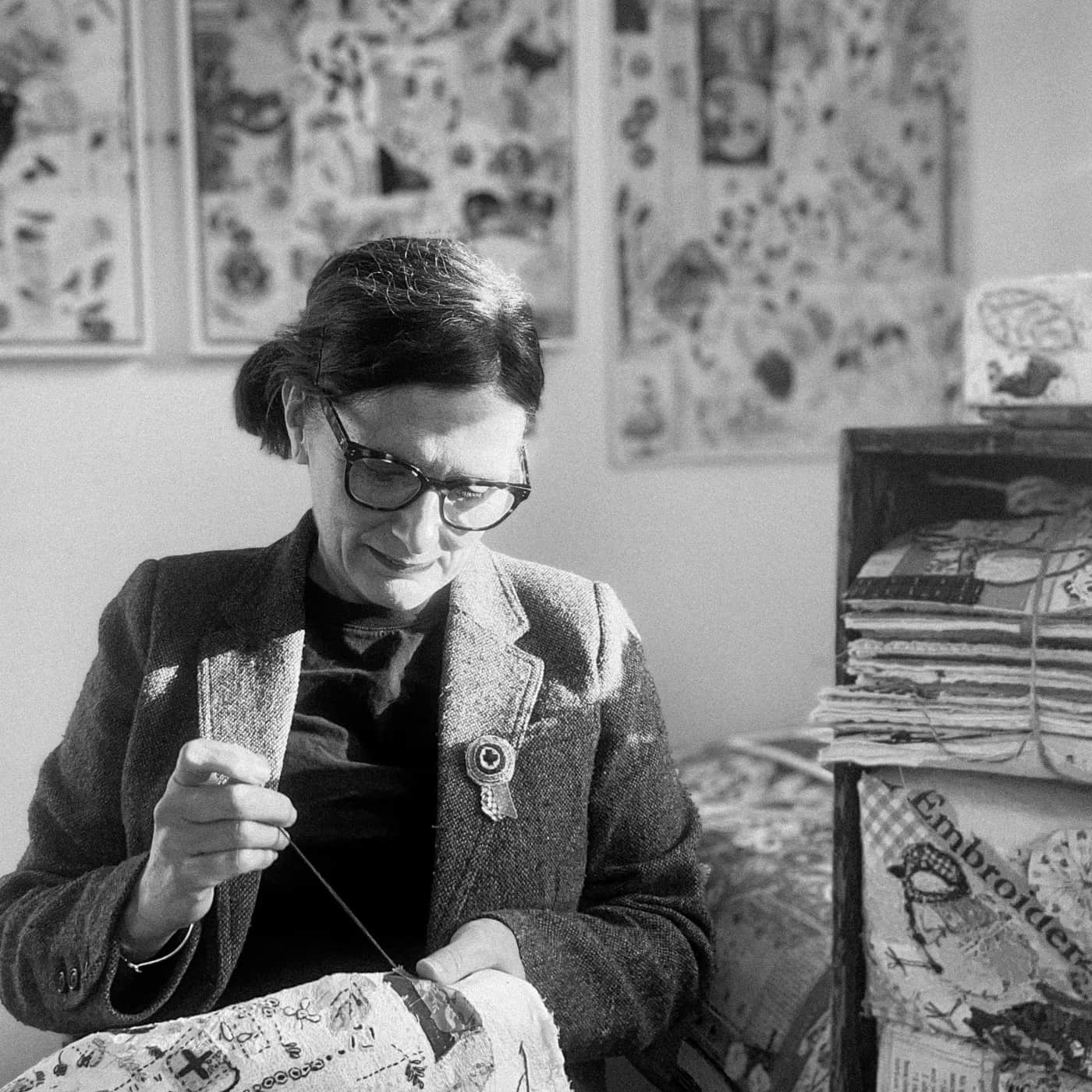
Suzette Smart, Mary The Carrier Pigeon, 2025. 43cm x 43cm (17″ x 17″). Mixed media, collage, hand and machine stitching. Fabric, paint, variety of threads.Suzette Smart in her studio
Typography & stitching
How do you choose what words to include, and how do you incorporate the text into your work?
The words I feature come to mind when I’m working on a piece, but then sometimes they don’t come at all.
I use a variety of methods to incorporate text and choose the one that best suits the work. I might use free machine stitching, but I also print various type sets to cut up and piece back together. Those manipulated letters are then transferred onto my chosen fabric by painting with gesso and then pushing the printed letter into the wet paint. After it dries, I sponge the paper away.
If a letter somehow ends up being placed upside down or back to front, I might let it go. But if it’s jarring to the work, I’ll correct it.
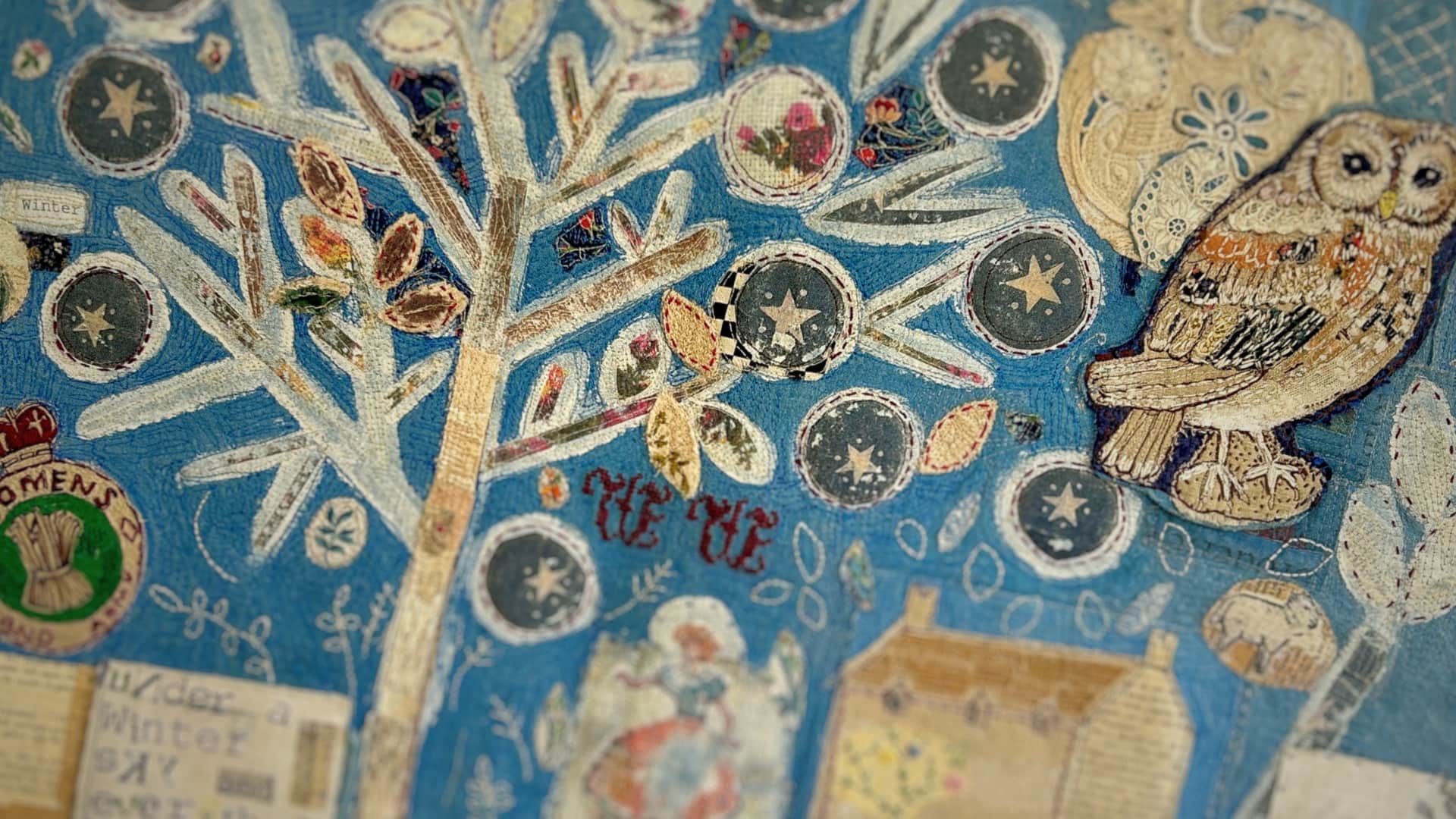
Suzette Smart,Under A Winter Sky (detail), 2023. 65cm x 48cm (26″ x 19″). Mixed media, collage, hand and machine stitching. Fabric, paint, variety of threads.
When including paper elements in your work, how do you attach them without damaging them?
I use Bondaweb fusible webbing to give stability to the paper and then attach it like I would a piece of fabric. If it’s a sample that gets handled at a workshop, the paper may tear. I don’t mind that, though, and I make the repair part of the story.
I also liberally rub on clear furniture wax to add a little more patina to the paper and help it better blend into the work.
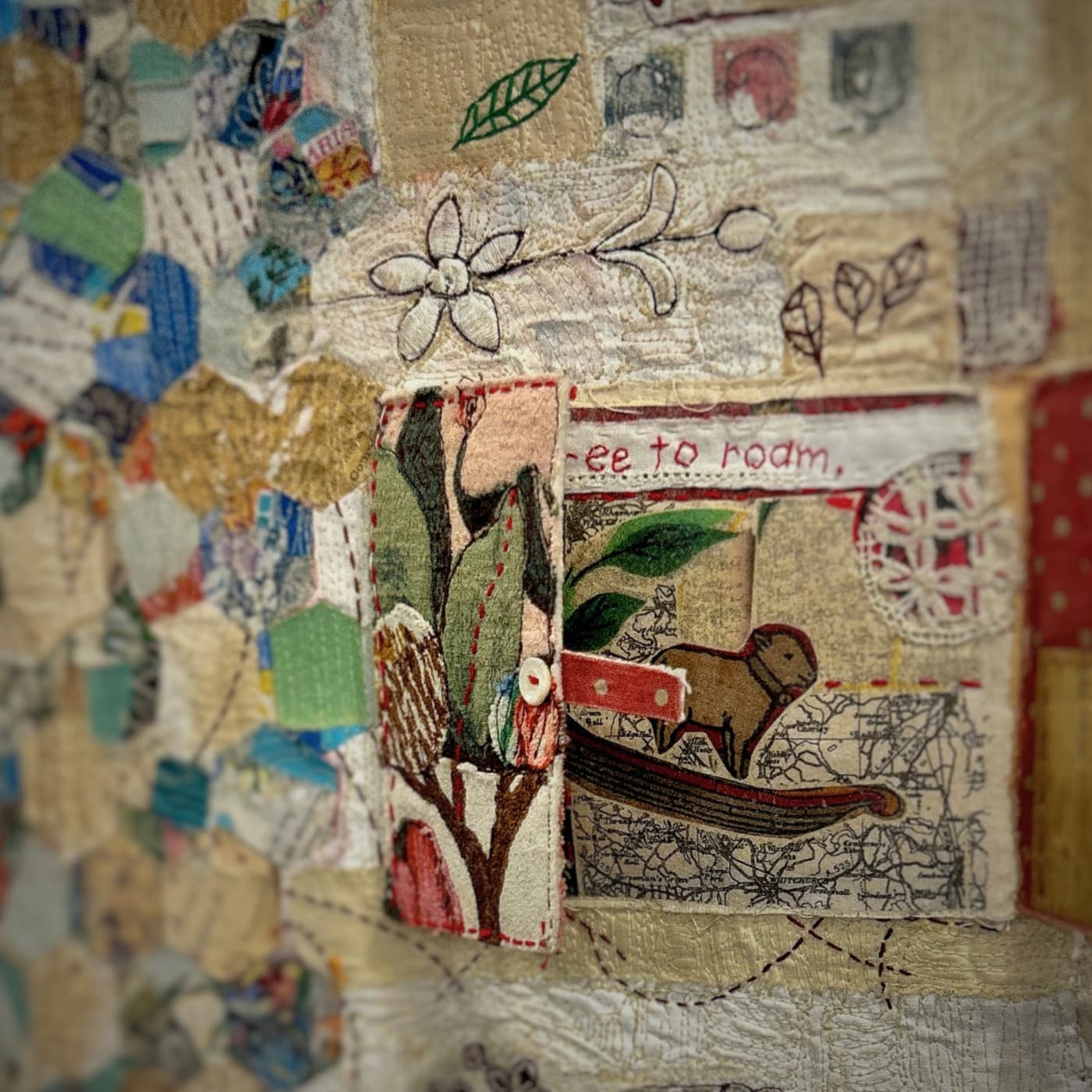
Suzette Smart, Free to Roam, 2023. 88cm x 146cm (35″ x 57″). Image transfer, collage, free machine and hand stitching. Paint, fabric, paper, thread.Suzette Smart, Free to Roam (detail), 2023. 88cm x 146cm (35″ x 57″). Image transfer, collage, free machine and hand stitching. Paint, fabric, paper, thread.
When it comes to hand stitching, do you have any preferred stitches?
I like mixing up running, back and stem stitch to alter a line as if I were using a pencil. Sometimes a new stitch comes along, like the fishbone stitch, and I can’t get enough of it.
I’ll go down to a single strand if I have some fine detailing.
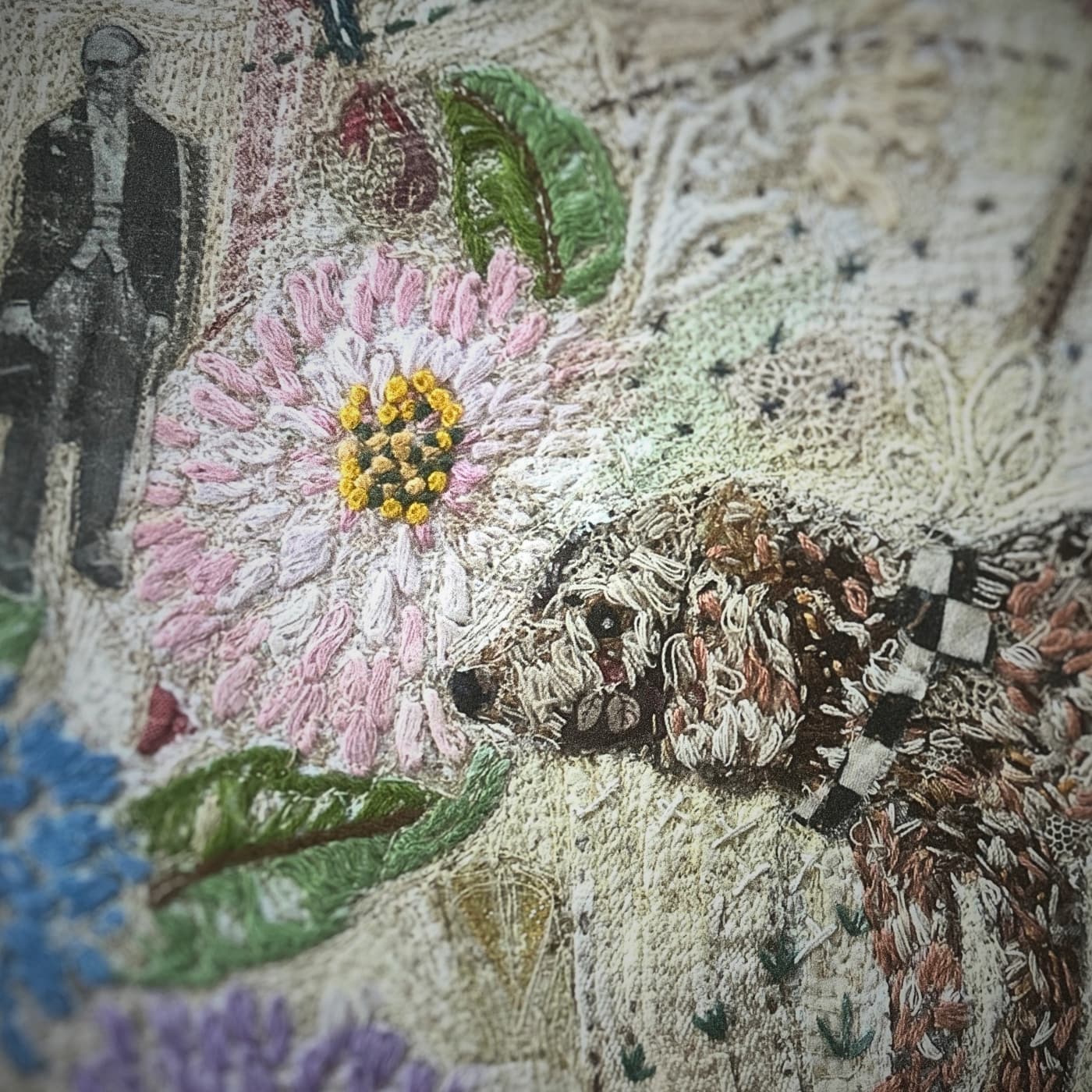
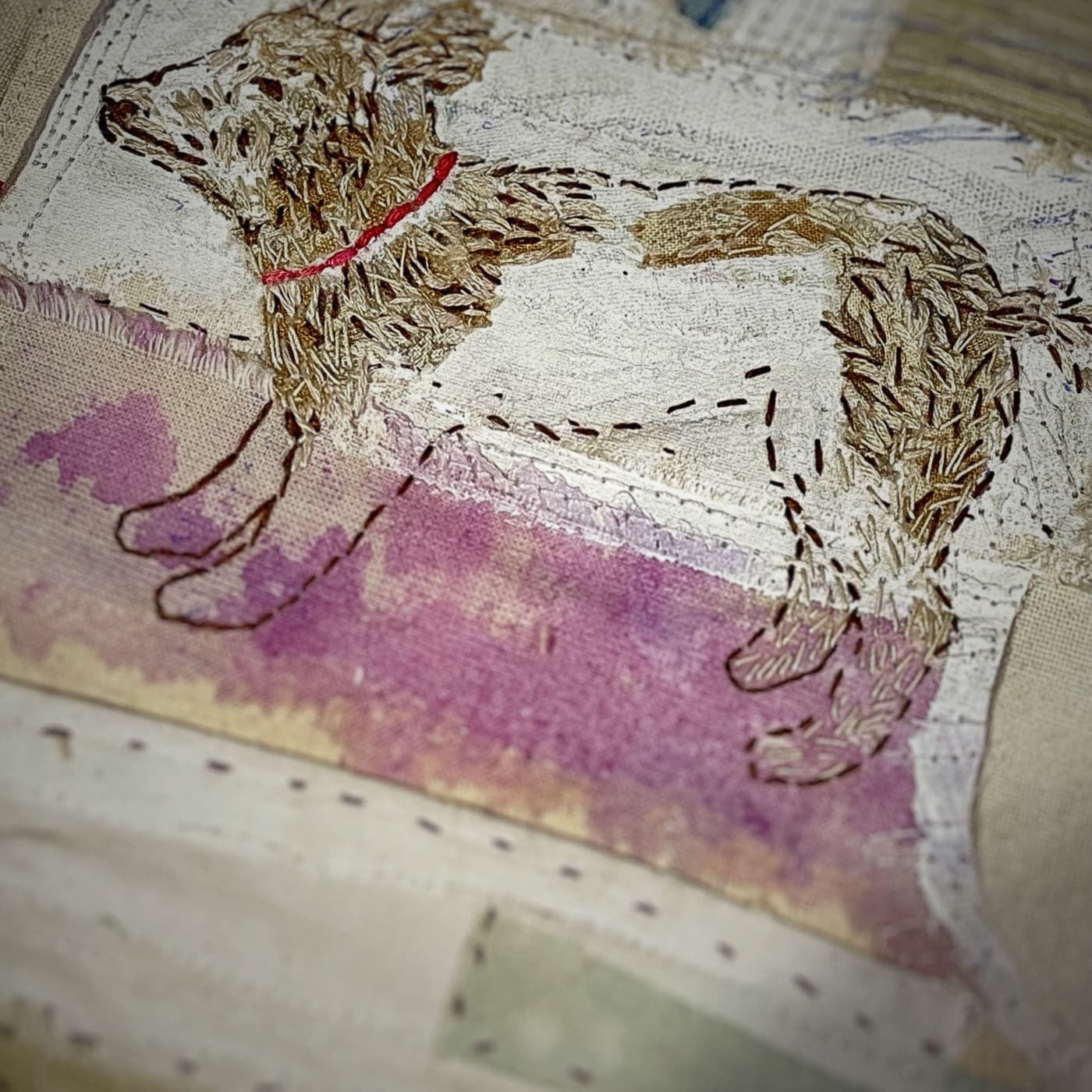
In this detailed image from A Turn in the Road, I’ve used long and short stitches for the dog and then running and back stitches to outline.
The threads were chosen for their various thickness, texture and colour. The old crochet thread I’ve used adds depth to the dog’s coat with its thickness and the way it sits on the surface.
“I have threads I like at the moment, but I’m happy to mix up perlé, linen, wool, stranded, old and new.”
Suzette Smart, Textile artist
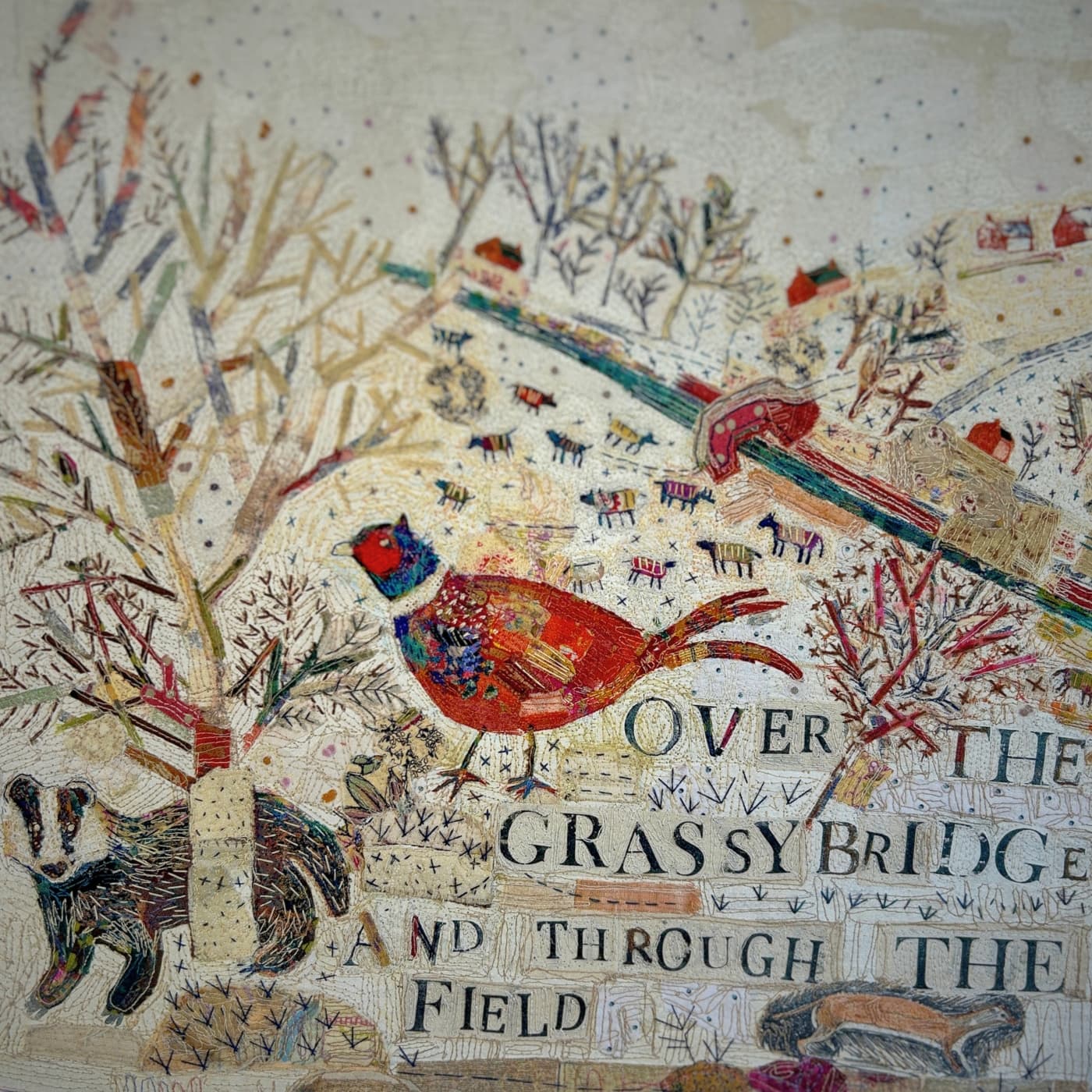
Suzette Smart, A Turn in the Road (detail), 2022. 43cm x 43cm (17″ x 17″). Mixed media, collage, hand and machine stitching. Fabric, paint, variety of threads.Suzette Smart, Over the Grassy Bridge, 2022. 43cm x 43cm (17″ x 17″). Mixed media, collage, hand and machine stitching. Fabric, paint, variety of threads.
Inventive titles
What was the inspiration for Over the Grassy Bridge?
This work features one of my favourite walks from home, and the grassy bridge takes me across the canal and through the field.
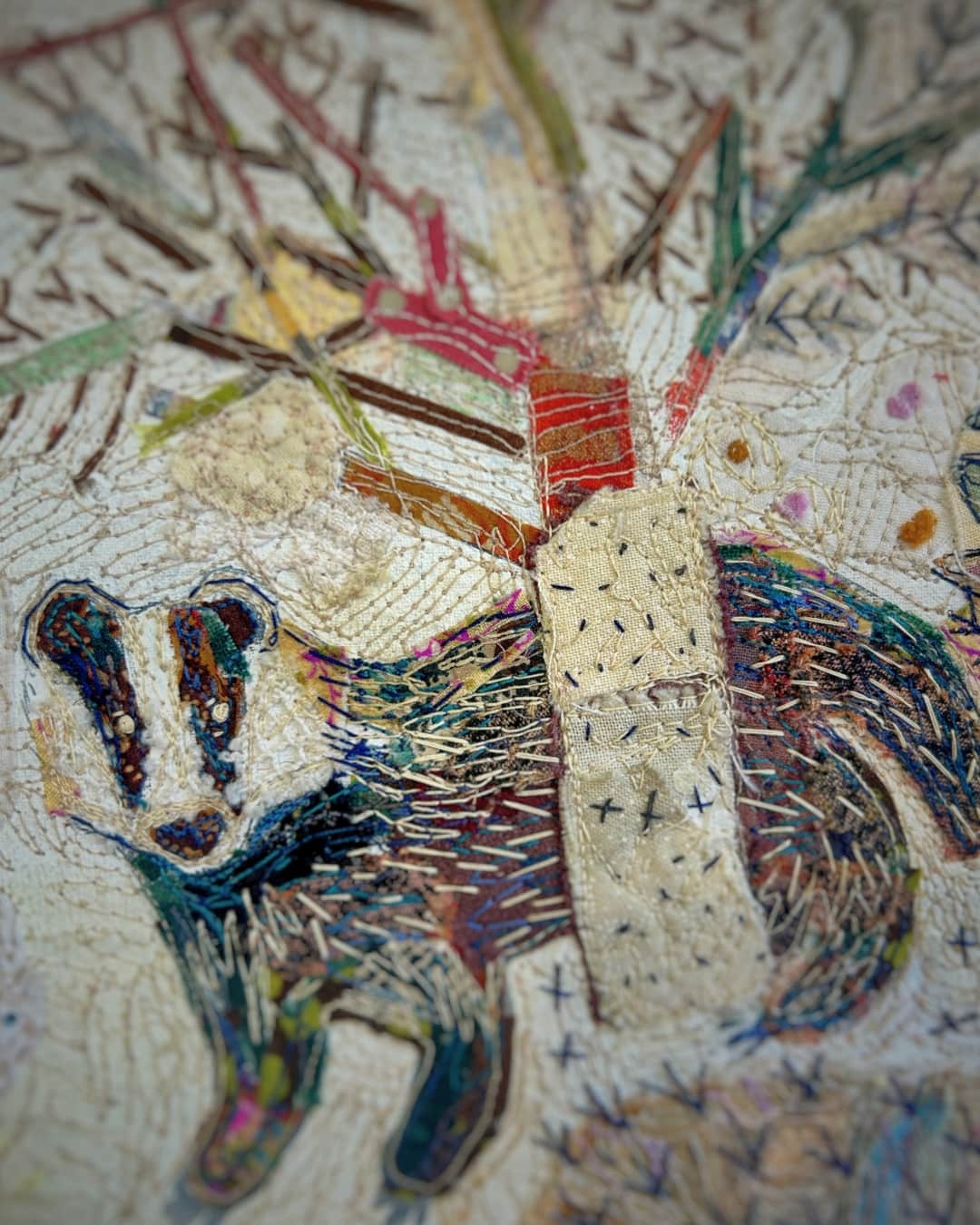
There’s a badger in the story because we pass badger’s door on our towpath walk. Someone has carved the door and name into the bark of an old tree.
The reds of the little cottages are a nod to the colour of the traditional brickwork in this area on the Welsh/Shropshire border.
Suzette Smart, Over the Grassy Bridge (detail), 2022. 43cm x 43cm (17″ x 17″). Mixed media, collage, hand and machine stitching. Fabric, paint, variety of threads.
Tell us about the lyrical name of your work Springtime Conversation: Sipit…Pipit…Sipit…
The bird featured in this work is a Meadow Pipit, and the title is his song. We would see them perched on top of the heather when walking coast to coast in Yorkshire.
A path stitched with backstitch and running stitch creates a focus within the work. We had a backpack for our little dog, and when we let her out, she would run along the path with happiness.
The paper and fabric animals are a reference to the distinctive Belted Galloway cattle we’d seen on this part of the walk.
The blues in this piece take me straight back to when the heather-coloured moors met with a perfect blue sky.
Suzette Smart, Springtime Conversation, 2023. 43cm x 43cm (17″ x 17″). Mixed media, collage, hand and machine stitching. Fabric, paint, variety of threads.Suzette Smart, Springtime Conversation (stitching in progress), 2023. 43cm x 43cm (17″ x 17″). Mixed media, collage, hand and machine stitching. Fabric, paint, variety of threads.
Developing personal narratives
Will you be sharing some of your storytelling techniques in your upcoming Stitch Club workshop?
Students will create a layered collage drawing on different elements from within my work. I’ll be presenting different ideas for collage, including how to create a new fabric from fusing special fabric scraps. I’ll also show how to elevate keepsakes into small treasures on a platform of layered fabrics.
I hope students will take away practical ideas for creating their own stitched collage. More importantly, though, I hope they find some ideas that lead to identifying their own motifs for creating narratives that are personal to them.
Tell us a bit about your maker space…
My home studio has two windows that provide wonderful light in which to work. I’ve thought about getting a studio away from home, but if I’m working on a project, I’ll quite happily stay up until one in the morning, which wouldn’t work anywhere else.
I also have so many things around me that can serve as reference or are simply just waiting to be included.
We’ve lived here for 21 years, and I have all the familiar of the outside space too. I head for the canal around the corner if I need thinking time during the day.
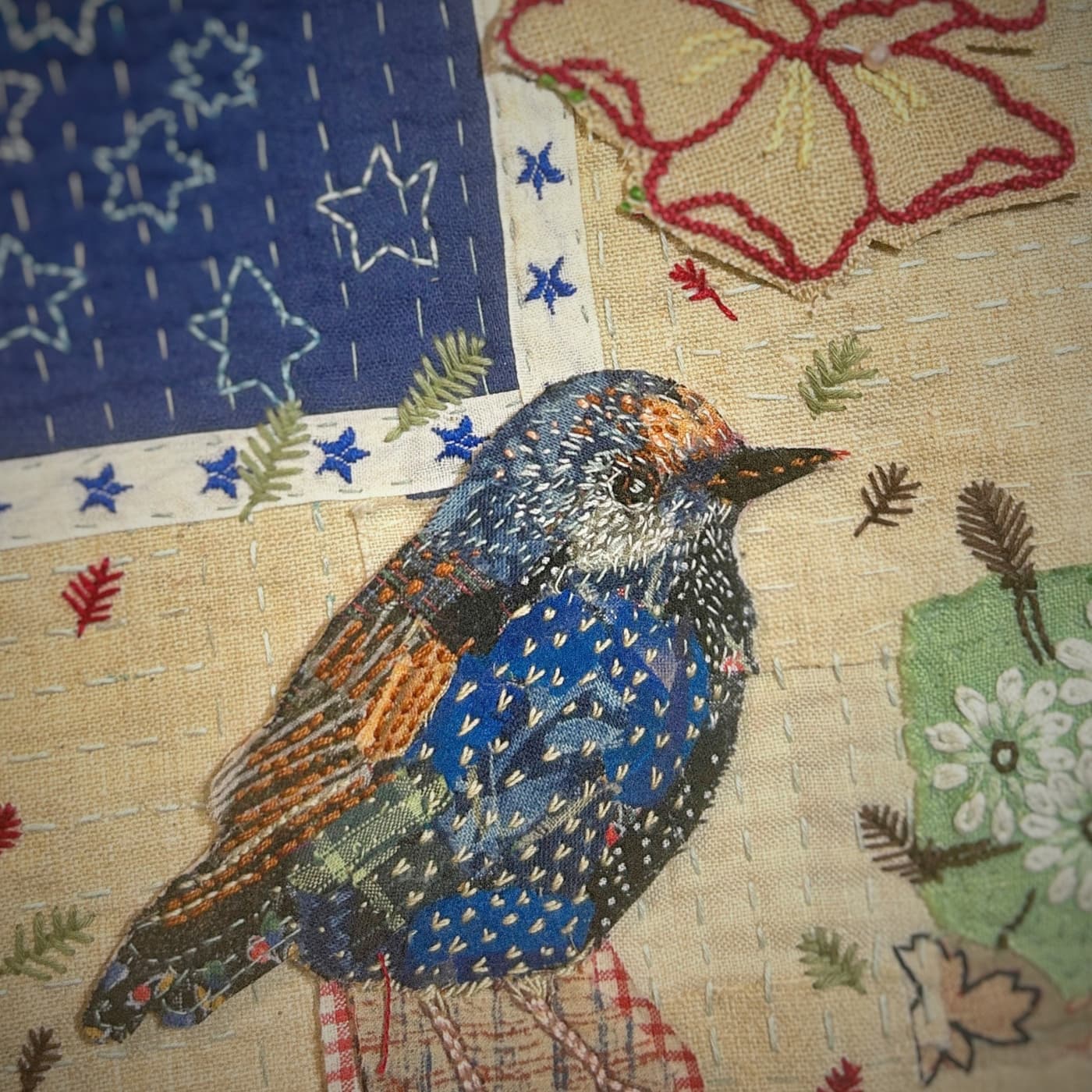
Suzette Smart, Starry Night, 2025. 22cm x 24cm (9″ x 10″). Collage and hand stitch. Vintage linen, other fabrics, threads.Suzette Smart, Free to Roam (detail), 2023. 88cm x 146cm (35″ x 57″). Image transfer, collage, free machine and hand stitching. Paint, fabric, paper, thread.
What are your must-have tools, supplies or materials?
I love gifted fabrics, as they bring something new and unexpected to my work. They often take me on a new journey of discovery. I also have favourite dark and light threads for hand and machine stitching. I use them to draw, blend and highlight.
I work on a Bernina 1008. It’s a real workhorse, and I’m always apologetic when taking it in for service!
You have a vibrant Instagram feed. What are your thoughts about using social media?
Instagram has given me incredible opportunities to grow my business, but I’m grateful I found my creative style when I did. Following your own creative journey can be challenging when there’s so much out there. It’s easy to absorb other people’s work without realising it.
That said, social media is fantastic for networking and connecting with an audience. It’s also a great way to document your development as an artist.
Suzette Smart, Free to Roam (detail), 2023. 88cm x 146cm (35″ x 57″). Image transfer, collage, free machine and hand stitching. Paint, fabric, paper, thread.
What excites you most about teaching, and what are some of the challenges students bring to your workshops?
My workshops are inspired by whatever I’m working on at the time. I love sharing the excitement of discovering a new material, technique or idea and then seeing students’ personal spin. Everyone brings different skills, materials and colour preferences, and that individuality really shapes the work that comes out of the sessions.
A challenge is that experience levels vary a lot, so I design workshops that can be accessed at different stages. I provide a starting point but leave plenty of space for personal interpretation.
I also always bring a wide range of samples and ideas, so students can work at a level that feels right for them. And I bring practical resources like motif templates, as drawing can sometimes be a barrier. I try to remove as many obstacles as possible so that students are free to focus on creating art with fabric and thread.
This article comes from Atlas Obscura’s Places newsletter. Subscribe or manage your subscription here.
In Shiodome, Tokyo, a hulking, storybook contraption clings to the side of the Nittele Tower at Nippon Television’s headquarters: the Giant Ghibli Clock. Designed by legendary animator Hayao Miyazaki, it’s less a timepiece than a mini mechanical theater—gears, doors, figures, and little surprises that feel like they’ve wandered out of a fantastical workshop and onto a city skyscraper. No need to buy a ticket: commuters can just look up and catch a burst of whimsy in the middle of a very modern district.
Before we were able to tell time by glancing at our wrists, reaching into our pockets, or calling out to Siri, the local clock tower was how many people marked their days. Because they were highly visible civic resources, many clock towers saw a remarkable level of craftsmanship and attention to detail. SEE THE FULL LIST
My New Favorites in the Atlas
Carved scenes of sex work and unglamorous labor complicate a heroic statue in Hamburg dedicated to the writer Hans Albers.
An unusual cast-iron bridge in Nantwich, England carries a historic canal across a busy main road.
This family-run collection in Cambodia known as the Vimean Sokha Museum holds tons of antique electronics, cameras, and motorbikes.
Did You Know?
Centuries ago, astronomical clocks were the ultimate statement in horological prowess. During the heyday of grand astronomical clocks, between the 14th and 16th centuries in Europe, these massive constructions were often decorated as ornate pieces of art featuring multiple faces, moving figures, carved ornamentation, and intricately displayed figures.
Today we’re spotlighting a collection of recently finished striking sweaters from Ravelers featuring fearless color, bold graphic motifs, and altogether joyful visual impact. If you’ve been craving color confidence and plenty of yarny personality, you're in the right place!
This route that used to be the same taken by Houston’s first electrified streetcar system that would take the Heights neighborhood residents to the "big city"( until the 1940's), now for about two miles in between the northbound and southbound lanes on Heights Blvd shows you a world of wonder.
Every half mile or so you will be greeted with an open-air exhibit of works from various Texas sculptors. Everything from giant blue cell phones, paper airplanes, Savoy cabbages, spheres made from hubcaps, and stacked sofas have been displayed.
The sculptures change after every 9 months or so and are for sale. It is common to see formerly displayed ones outside of many homes and businesses in the Heights area.
On September 29, 1991, during the Siege of Bjelovar Barracks, the "Bedenik" ammunition depot was detonated by Major Milan Tepić of the Yugoslav People's Army, who chose to blow up the facility rather than surrender it to Croatian forces. The resulting blast was so powerful it shook the entire city of Bjelovar and left a massive crater where the warehouse once stood. Eleven Croatian soldiers lost their lives in the explosion while trying to prevent the catastrophe.
Today, the site has been transformed into a peaceful memorial area. Visitors can walk through the forest paths to see the monument dedicated to the fallen defenders, a chapel, and an open-air museum featuring military equipment, including tanks and armored vehicles used during the war. It serves as a stark reminder of the "Bjelovar War" and the high price paid for the city's freedom.
This is a great example of Bulgaria's Orthodox heritage. From the outside this place looks quite plain (apart form the gilded domes and crosses on the roof). But step inside and you will be awed by the stunning frescoes that cover every inch of the walls and ceilings. Large chandeliers hang from the arched ceilings.
The domes apparently represent Christ and the writers of the four gospels, with the central one rising above the others.
If you like history, architecture or just want a peaceful place to sit, this is it.
Be careful on the marble floor though, there are a team of cleaners constantly mopping it.
I have been traveling my entire life. As a journalist, I've reported from places most people never see, like small towns in Malaysia and factory complexes in Tijuana. As a traveler, I've chased the unusual, the overlooked, the wonderful, and the natural around the world. I run marathons and rock climb, so discomfort in the name of discovery is basically my love language. And yet, until this past December, I had never once asked myself a simple question: how many of the fifty United States have I actually been to?
The answer came courtesy of Atlas Obscura, the travel and culture company I lead as CEO. We launched a new feature — a 50-state map where users can log the states they've visited. I sat down one evening, started clicking, and felt something unexpected: genuine suspense. When I finished, the number staring back at me was 39.
Thirty-nine states. Not bad. But also: eleven gaps. Eleven places I had somehow — through decades of movement and curiosity — never set foot in. And then I did the math: America's 250th birthday is July 4, 2026. That gave me a deadline. Suddenly, 39 felt less like an accomplishment and less like a finish line ... and more like a starting gun.
I wasn't alone in this feeling. Atlas Obscura recently partnered with YouGov to survey roughly 1,285 American adults about their travel habits and relationship to the fifty states. About 29 percent of Americans say visiting all fifty states is a lifetime goal. But only 4% have made it to 40 or more. I am going to be in rare company — and yet, paradoxically, that made the remaining eleven feel more urgent, not less. The survey also found that 53% of Americans have visited 10 or more states, which means nearly half the country hasn't even crossed that threshold. We are, it turns out, a nation of people who haven't fully seen our own nation.
The more I work at a travel company whose entire purpose is to show people the wonders hiding in plain sight, the more it seems to me that we should all lean more into exploration afar but also exploration at home.
Here is where the intellectual stakes come from for me. I majored in American Studies in college — specifically the counter-cultural strain of American History, the version that asks hard questions about who gets remembered and who gets erased, whose stories get told and whose don't. I became a journalist because I believe, at a cellular level, that there is no substitute for going somewhere in person. You cannot understand a place from a dateline. You cannot understand Americans — their humor, their grief, their contradictions, their resilience — without standing in their actual geography.
John Steinbeck wrote in Travels with Charley that he had discovered he did not know his own country. He was in his late fifties when he made that admission and set out to fix it. I find myself in a similar reckoning. I lead an American content company, a travel content company, one whose editorial mission is built on the idea that every place holds something astonishing. It would be a strange thing to have gaps in my own map.
So is this a patriotic exercise? That's a more complicated question than it sounds. The 250th anniversary — the Semiquincentennial, if you want to be formal about it — has become contested territory. For some, it's a moment of pride; for others, a prompt to ask harder questions about what exactly we're celebrating. But I’m taking a third path that cuts through this kind of false binary we find ourselves in: I am choosing to see more of the country, so that I can know our country and our people better.
And here is where Atlas Obscura shapes the mission entirely. I am not going to close out my eleven states by hitting the most obvious landmarks. That's not how I travel, and it's not what Atlas Obscura is about. Our research with YouGov found that 34% of Americans who travel to new states are most drawn to scenery and nature, and, while they're there, 68% say exploring local food is a top priority. The AO traveler hits the trails, eats the food, and goes further — past the familiar, toward the genuinely strange and wonderful.
So when I get to Bentonville, Arkansas, I'm definitely going to Crystal Bridges (though that museum — a world-class art institution dropped improbably into the Ozarks — is itself a kind of miracle), but I’m also going to The Bachman-Wilson House — a Frank Lloyd Wright home that was literally picked up and moved from New Jersey to the Crystal Bridges campus to save it from flooding. In Kansas, I’m going to Wamego, and, not only will I visit the Wizard of Oz Museum, I will also go to see the decommissioned nuclear missile silo that was the nexus of a drug operation that, by DEA estimates, accounted for 90% of America's LSD supply in the late 1990s. As someone who studied the American counter-culture in college, I feel almost obligated.
And in Bloomington, Indiana, I want to visit the Tibetan Mongolian Buddhist Cultural Center, founded by the Dalai Lama's brother, sitting quietly in the middle of the Indiana limestone belt — the kind of juxtaposition that makes you love this country's capacity for surprise.
Oh and I am definitely going to get myself to Carhenge, in Alliance, Nebraska — a full-scale replica of Stonehenge built from vintage American automobiles, painted gray, standing in the high plains. It is absurd. It is magnificent. It is exactly the kind of thing that makes me proud to work at Atlas Obscura.
Alexis de Tocqueville came to America in 1831 and spent nine months traversing it before writing one of the most perceptive analyses of American democracy ever produced. He understood that you had to move through a place to understand it. I have four months left and eleven states. The deadline is July 4th. The quest is on.
I invite any suggestions in the states I have ahead of me: Arkansas, Oklahoma, Kansas, Nebraska, Iowa, South Dakota, Wisconsin, Indiana, Idaho, Washington, Alaska. Email me at ceo@atlasobscura.com
Tucked along Birmingham’s Richard Arrington Jr. Boulevard, Books, Beans, and Candles isn’t just a store—it’s a portal. Billing itself as Alabama’s oldest and largest metaphysical shoppe, the space hums with the scent of incense and espresso, its shelves lined with arcane books, hand-poured candles, and curious relics of the occult. Visitors come to browse spellcraft supplies and crystals, sip tea or coffee, and linger among artifacts that seem to blur the line between the earthly and the ethereal.
But this shop is as much a gathering ground as it is a marketplace. On any given evening, you might find tarot readers flipping cards over steaming mugs during the monthly Tea and Tarot, or astrologers mapping the cosmos at Sips and Stars. Workshops on pagan traditions and esoteric practices draw locals and travelers alike, turning the space into a living, breathing salon for Birmingham’s mystical community—a place where curiosity meets the cosmos, one candle flame at a time.
Hultanäs railway station in Vetlanda municipality is a historic station on the Växjö-Åseda-Hultsfred narrow-gauge railway. It is no longer in regular service and is primarily used for tourist trains, such as the narrow-gauge steam trains of the museum railway.
The platform lies silent, as if time has decided to halt here. The gravel between the rails is overgrown with weeds and grass. The signs, their letters faded by sun and rain. On the tracks, the trains stand motionless, like metal skeletons waiting for a signal that will never come.
The windows are dull, some shattered. The locomotives still bear their numbers and logos. Inside, the cabins are empty: levers rusted, meters frozen in their last position. The seats are torn, the foam sticking out, and the floor is littered with leaves blown in through broken doors.
The carriages behind them tell their own stories. Seats are tilted or toppled, luggage racks hang loose, as if the trains, weary from years of running, have been placed here to finally rest, together on the same track, listening to the wind whistle along their empty corridors.
This article comes from Atlas Obscura’s Places newsletter. Subscribe or manage your subscription here.
On Bourbon Street in New Orleans, Jean Lafitte’s Old Absinthe House looks and feels like it belongs to another century. Andrew Jackson is said to have met the pirate Jean Lafitte in an upstairs room to ask for help manning ships against the British in the War of 1812. Today, the brick interior is lined with mementos left behind by visitors, its convivial history made visible.
Some stories of the past are told on restaurant plates and in Grandma’s cookie recipe. For anyone seeking to understand another generation and another era, food and drink can be powerful tools. From a Civil Rights-era restaurant that sustained activists to a candy shop reviving nostalgic treats to an English pub from the 12th century, these places offer delicious lessons in history. SEE THE LIST
My New Favorites in the Atlas
This statue, known as “Los Lagartos,” commemorates a live alligator pond that was once in this El Paso plaza.
The Cave Creek Tubercular Cabin in Arizona is a rare remnant of a bygone era of medical treatment, when tuberculosis patients were isolated at sanatariums.
The Hull Lifesaving Museum was once the home base for shipwreck rescues in Boston Harbor.
Did You Know?
Deep in Switzerland’s Val-de-Travers—absinthe’s birthplace—devotees keep the “green fairy” tradition alive by stashing bottles in the forest for fellow hikers to find and share. It’s part folklore, part scavenger hunt.
Brave heart! An in-depth chat with JANET FIELDING who played the irrepressible Tegan opposite the Fourth and Fifth Doctors.
ALEX KINGSTON talks about playing River Song alongside the Tenth, Eleventh and Twelfth Doctors, as well as her on-going audio adventures with Big Finish, and her new book Stormcage.
Meet MILES TAYLOR, who is assuming the role of the Eleventh Doctor in a new range of audio dramas!
Monster actor RICHARD PRICE shares his memories of playing Cybermen, a Sea Devil and a Scaly Man!
40 Years of Fundraising! Looking back at the incredible artistry and charitable work of the Hyde fundraisers – including their contribution to last year’s season finale.
We examine the forbidden text of the Veritas, in our FACT OF FICTION feature on the mind-bending Twelfth Doctor episode Extremis.
Top Trumps! A stat-busting guide to Doctor Who editions of the popular card game.
Back to 1985… Blake’s 7’s Paul Darrow joins the cast of Doctor Who…
We assess the battle plans of the various factions in Remembrance of the Daleks.
The inner workings of the Dalek City on Skaro explored!
The Fifteenth Doctor and Mel learn more about the Daleks’ plans, in the latest instalment of Corruption of the Daleks…
Regular features
GALLIFREY GUARDIAN: the latest news including the 4K Ultra HD release of the Paul McGann TV movie.
Reviews – including the latest audio releases, books and action figures.
Other Worlds – the essential guide to new stories in Doctor Who’s expanded universe – featuring a chat with ANNEKE WILLS who played companion Polly.
Prizes to be won – including the new Season 21 Limited Edition Blu-ray boxset!
Doctor Who Magazine Issue 627 is on sale Thursday 5 March 2026 from panini.co.uk and TG Jones priced £7.99 (UK).
Also available as a digital edition from pocketmags.com priced £6.99.
Along the iconic East Street in the neighbourhood of Camp in Pune, there is an old heritage stone building which has been recently turned into an art gallery.
Vesavar Art Gallery was founded by Kavita Bhandari and artist Pranali Harpude with the aim of creating an environment to showcase contemporary Indian art. The founders identified this heritage building which is more than a hundred years old and recognized its potential as a space for establishing such an art hub. The restoration of the building was meticulously carried out in great detail by architect Sandeep Shah. The architectural elements of the building such as the wooden staircase and the ceiling were carefully preserved to maintain the building’s old world charm and vintage essence.
The walls have been kept white so as to offer a clean and simple backdrop to highlight the displayed artwork. The artistic wooden trussed roof of the gallery is like a step back in time. The gallery has blended the old with the new and has created an art space which celebrates the rich cultural heritage of the city. The art gallery aims to create a supportive environment for artists to showcase their talents.
Tucked into the quiet cemetery of Castiglione della Pescaia, overlooking the Tuscan coastline, lies the grave of Italo Calvino—an author whose imagination ranged far beyond the visible world. Unlike monumental tombs dedicated to literary giants, Calvino’s resting place is strikingly modest, almost deliberately so, echoing his lifelong resistance to grandiosity and rigid labels.
Calvino spent many of his later years in this coastal town, drawn to its light, its sea, and its balance between nature and human order—concerns that recur throughout his work, from Invisible Cities to Mr. Palomar. The cemetery itself feels less like a city of the dead than a contemplative garden, where the horizon opens outward, mirroring Calvino’s own literary obsession with perspectives, structures, and unseen connections.
Visitors often remark on the quiet irony of the setting: a writer fascinated by labyrinths, cosmic distances, and imaginary architectures laid to rest in a place defined by simplicity and calm. Yet it is precisely this contrast that makes the grave meaningful. Here, imagination does not demand spectacle; it rests lightly on the earth, like one of Calvino’s “lightness” virtues, inviting reflection rather than reverence.
For readers, pilgrims, and wanderers, Calvino’s grave is less an endpoint than a pause—an understated marker reminding visitors that the most expansive worlds can emerge from the most unassuming places.
The monastery in Bzovík was founded between 1127 and 1131, it's charter being issued in 1135. Originally a Benedictine monastery (dedicated to the first Hungarian king, St. Stephen), around 1180 it fell under the influence of a religious order called the Premonstratensians. This new leadership expanded monastic teaching to include new economics and agriculture.
Monastic strongholds were often the subject of attack during the 15th century, and as such the building was burned down several times, immediately repaired and rebuilt only to be razed again. In 1530 it was even rebuilt into a vast fortified manor house by a Slovakian oligarch Zigmund Balasa, adding dwellings for soldiers and farming. It was again burned down in 1620, re-established as a church only to be conquered in 1678.
The complex finally fell into a permanent state of deterioration in the early 19th century with habitation ceasing after World War I. Archaeological and architectural study of the site began in the 1930s, though Pevnosť Bzovík suffered under both world wars. Today the fortifications are under general reconstruction, though the church related structures at its center are completely crumbled. But this wonderful ruin remains freely open to the public. Its extensive history can be easily researched online.
A large, rusted spherical pressure vessel set in the woods behind an old, closed down schoolhouse built to store liquefied gas or other materials under high pressure.
A "Horton Sphere" (or Hortonsphere) is a relic from Connecticut's industrial past, looking something like a vintage lunar lander from the golden age of science fiction.
The sphere sits in a fenced off lot (with some breaches in the fencing) behind the defunct Laurel Hill School along with two other crumbled structures. It stands as a local landmark that once held various substances for industrial use. Research tells of other Horace Horton spheres similar to this 37.5' giant in Milford CT and Danbury CT, however those have been swallowed up by time.
"Horton Sphere" is a trademarked name for spherical pressure vessels, invented by the Chicago Bridge & Iron Company after its founder, Horace Ebenezer Horton (1843-1912).
At first glance, the Mathews Museum appears to be a small local history museum in a quiet coastal Virginia town. Step inside, however, and it becomes something more intimate: a place that preserves how community itself once functioned—through shared spaces, shared knowledge, and shared survival.
At the heart of the museum is an immersive, walk-through general store that does more than recreate a historic interior. It reflects a time when general stores were not simply places to buy goods, but the central machinery of rural life. In communities like Mathews County—shaped by waterways, distance, and limited infrastructure—the general store was where news traveled, credit was extended, and relationships were maintained, often doubling as the local post office where commerce, communication, and social life converged in a single room.
Visitors move directly through the store space, surrounded by period goods, counters, and displays arranged as they once were. The experience feels less like observing history and more like stepping into it, offering a rare sense of how everyday life unfolded when community was not an abstract idea, but a necessity.
Additional rotating exhibits draw from donated artifacts, family histories, and local lore, quietly expanding the story of a Chesapeake Bay county that long existed outside the pace of industrial America.
A wonderful relaxing visit. It contains so many intricately knotted and weaved rugs and a lovely hand-woven wedding cape. It was exquisite. There was also a hands-on workshop where you can learn how to weave.
Finishing your visit on the rooftop with tea and an assortment of authentic Moroccan pastries provides a lovely view of the medina from above. A wonderful visit from start to finish.
This resin and metal sculpture was created by sculptor Sandrine Plante-Rougeol for Memory Week 2019. This sculpture, acquired by the City of Bordeaux and inaugurated on December 2, 2019, is a tribute to the enslaved people, in remembrance of their suffering. So that we never forget these crimes against humanity—the slave trade and slavery itself—and so that they may never happen again.
Plante-Rougeol, a descendant of enslaved people herself, is a committed figurative sculptor, a Zorey of Réunionese and Auvergne descent. The artist’s work invites viewers to think of her work “as a connection of symbols interwoven in space and time.” The symbol of the tree of life and its roots linking heaven and earth also recalls African animist beliefs.
The tree bears three branches in reference to the triangular trade. Each enslaved figure is turned in a different direction, representing three emotions: anger, fear, and abandonment, stifled beneath the blindfolds covering their eyes in order to strip them of all bearings—their names, their languages, and their beliefs.
“Strange Fruit” is also a mobile whose movement, when set in motion through its metal hoops, recalls the rocking motion of slave ships on the ocean. These hoops come from wine barrels, in reference to Bordeaux, the city for which this sculpture was created.
Bordeaux was France’s second-largest slave-trading port after Nantes, with roughly 480 to 500 expeditions departing between 1672 and 1837. These voyages deported approximately 130,000 to 150,000 enslaved Africans to the Americas, driving the city’s 18th-century “golden age” wealth through the import of sugar, coffee, and cotton.
The Musée d'Aquitaine in Bordeaux hosts a permanent exhibition on this history. In recent years, the city has begun to more openly acknowledge its past, including the addition of plaques to streets named after slave traders and the installation of a statue of Modeste Testas, an enslaved woman.
A bronze statue of Hans Albers stands just off Hamburg’s Reeperbahn, the city’s historic red-light and entertainment strip near the port. Albers, a film star of the 1930s and 1940s, became synonymous with the surrounding St Pauli district through movies and songs that romanticised sailors, bars, and nightlife, especially Auf der Reeperbahn nachts um halb eins (“On the Reeperbahn at Half Past Midnight”). At first glance, the monument reads as a straightforward tribute to a local icon in his natural habitat.
What most visitors miss, however, is what unfolds below the statue. A series of low reliefs carved into the base depict scenes often read as everyday life from the surrounding district rather than its neon-lit image. One relief shows a naked woman riding a crawling man while whipping him, an explicit reference to domination, sex work, and power. Nearby, another figure scrubs the floor beneath urinals, grounding the monument in the unglamorous labour that keeps the nightlife district running.
These scenes are not hidden jokes or later additions. They were part of the monument from the start and sparked controversy. By placing the heroic figure above stark, physical realities, the statue serves as a candid social snapshot rather than a simple memorial. The statue implies that the Reeperbahn’s myth is built on the people, services, and exchanges that keep it alive.
This perspective becomes clearer when looking at the artist responsible for the monument. Created in 1986 by the late Jörg Immendorff, a painter and sculptor known for political symbolism and provocation, the monument reflects his style and life. Immendorff battled a serious illness in his later years and sought escape through drug use and controversial behaviour, including a widely publicised cocaine-fuelled orgy involving prostitutes.
![[personal profile]](https://www.dreamwidth.org/img/silk/identity/user.png)
![[syndicated profile]](https://www.dreamwidth.org/img/silk/identity/feed.png) atlas_obscura_feed
atlas_obscura_feed